

Fix and Flip Loans: The Investor’s Guide to Arizona Real Estate Funding in 2026
September 6, 2026
Short Term Fix and Flip Financing: The 2026 Investor’s Guide to Rapid Capital
September 8, 2026Fix and Flip Loan Requirements: The 2026 Investor’s Pre-Funding Checklist
In Arizona’s 2026 market, your credit score is the least interesting thing about your deal. While traditional banks obsess over your W2 history and take weeks to process a “Full Review” on a condo, the best properties are already gone. You’re losing to cash buyers because you’re fighting a 1990s bureaucracy. It’s time to stop. Understanding the modern fix and flip loan requirements isn’t about jumping through hoops; it’s about proving the math of your asset.
You need a partner who moves as fast as a Phoenix summer. We know the anxiety of an unverified rehab budget or a looming closing date. This guide eliminates the guesswork. You’ll learn exactly what documentation secures fast, local funding and how the After-Repair Value (ARV) dictates your leverage. We’re laying out the 2026 pre-funding checklist so you can stop worrying about the paperwork and start winning the bid. From bank statement options for the self-employed to asset-based criteria, here is your roadmap to closing in days, not months.
Key Takeaways
- Shift your mindset from personal credit to deal math by treating fix-and-flip loans as asset-based tools rather than traditional mortgages.
- Master the specific 2026 fix and flip loan requirements that prioritize property value and rehab accuracy over your W2 income.
- Leverage local Arizona market expertise to bypass bank red tape and navigate Maricopa County closing timelines with confidence.
- Discover why a 600+ credit score and a solid After-Repair Value (ARV) calculation are often enough to secure fast hard money funding.
- Streamline your path to a term sheet with a five-step submission process designed for speed and clarity.
Deal Readiness: The Essential Fix and Flip Loan Framework
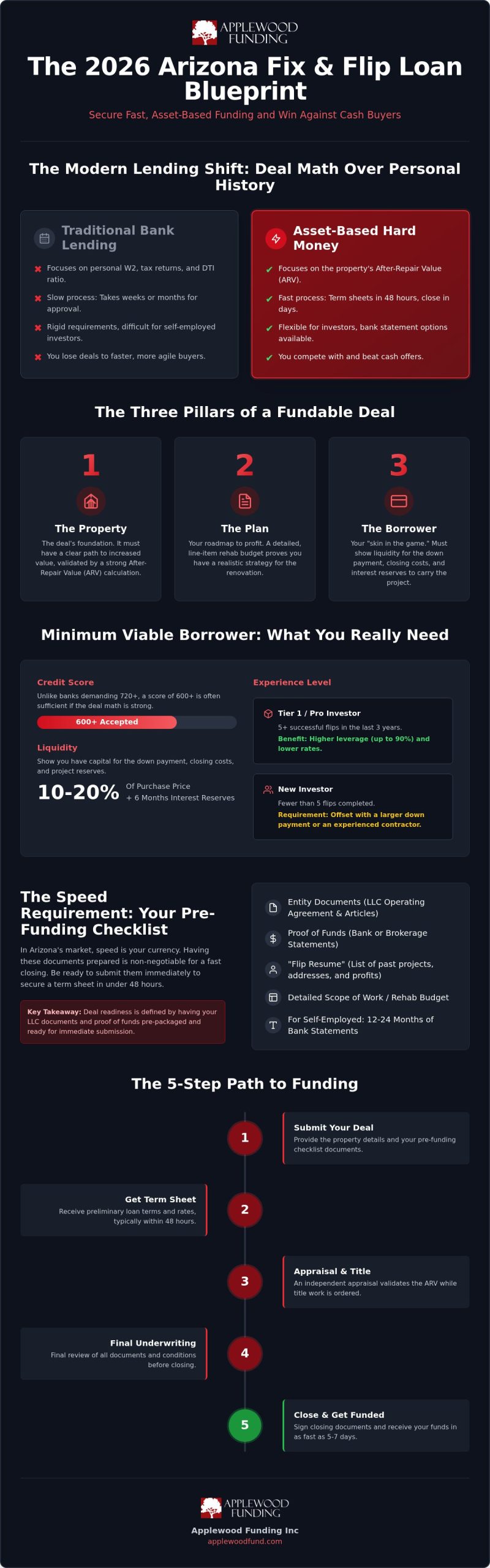
Traditional banks view real estate through the lens of a personal mortgage. They want your life history, your tax returns, and a mountain of signatures. In the fast-paced Arizona market, that’s a recipe for losing out to cash buyers. A fix-and-flip loan is different. It is an asset-based financial tool designed specifically for investors who need to move now. Understanding the core fix and flip loan requirements starts with realizing that the property is the star of the show, not your personal debt-to-income ratio.
Before you scout your next project, you must understand the business of What is property flipping? at an institutional level. It isn’t a hobby; it’s a high-velocity business. To succeed, you must align with the ‘Three Pillars’ of a flip loan. First, the property must have a clear path to value. Second, your plan must be a realistic, line-item rehab budget. Third, you as the person must show the liquidity to carry the project to the finish line. Private hard money cuts through the red tape that kills deals at big banks.
Why Asset-Based Lending Changes the Rules
Banks obsess over your past. Private lenders look at your future. Asset-based lending focuses on the property’s potential and its After-Repair Value (ARV). This shift changes everything for self-employed investors or those with complex tax situations. If the collateral is strong and the margins make sense, the deal is fundable. We see high-demand Arizona markets where properties move in hours. In these scenarios, Applewood Funding prioritizes deal math over W2 history. We look at the equity and the exit strategy. If the numbers work, we work.
The Speed Requirement: Beating Cash Buyers
In Scottsdale or Phoenix, speed is the only currency that rivals cash. You don’t have weeks to wait for an appraisal or a committee. You need the ’48-Hour Rule’ for your preliminary numbers. If you can’t get a term sheet in two days, you’ve already lost the house. The secret to a 5-day close isn’t just the lender; it’s your preparation. Having your ‘Entity Docs’ like your LLC Operating Agreement and Articles of Organization ready to go is non-negotiable. Deal readiness is defined as having your LLC documents and proof of funds pre-packaged and ready for immediate submission. Investors who master short term fix and flip financing understand that preparation and lender speed are what separate winners from those watching deals slip away.
Borrower Qualifications: Financials, Credit, and Experience
Most investors think they need a perfect financial profile to secure funding. They don’t. In 2026, the fix and flip loan requirements are more flexible than traditional bank mandates because the property acts as the primary security. Lenders look for a “Minimum Viable Borrower.” This means you need enough liquid cash to cover the down payment, closing costs, and at least six months of interest reserves. Typically, having 10% to 20% of the purchase price ready to go serves as the “skin in the game” that lenders require to fund your vision.
Don’t let a 620 credit score scare you away from a great deal. While big banks want 720 or higher, many hard money lenders in Arizona accept scores as low as 600. A lower score might mean a slightly higher interest rate, but it won’t kill the deal if the property margins are strong. You can check the Forbes guide to fix and flip financing to see how these leverage ratios compare across the national landscape. In our local market, the focus remains on your ability to execute the project and exit quickly.
Experience acts as a powerful multiplier for your loan terms. Lenders often use tiered programs where your history dictates your cost of capital. A “Tier 1” investor with five or more successful flips in the last three years will access lower interest rates and higher leverage, sometimes up to 90% of the purchase price. If you’re a beginner, you can offset a lack of experience by bringing a larger down payment or partnering with a licensed contractor who has a proven track record in Maricopa County. Smart investors also explore rehab loans for real estate investors to understand how renovation capital structures can be tailored to their experience level and project scope.
The Self-Employed Advantage: Bank Statement Loans
Full-time flippers in Arizona rarely have a standard W2. Traditional banks hate this. We love it. Instead of tax returns that show every business deduction possible, you can use 12 to 24 months of personal or business bank statements to prove income. This reflects your true cash flow and liquidity. It is the fastest route for professional investors to scale their portfolios without the headache of IRS transcripts. If your tax returns don’t tell the whole story, explore our Bank Statement Loans to see how we calculate your actual buying power.
Experience Documentation: Your Flip Resume
Speed requires organization. Build a “Flip Resume” before you find your next deal. This is a simple spreadsheet listing previous project addresses, buy/sell dates, and total profit generated. It proves you know how to manage a budget and a timeline. If you’re a first-time flipper, your resume should feature your licensed contractor’s credentials and their past projects. This builds instant credibility with the underwriting team. Ready to see how your background fits the 2026 criteria? You can connect with a local Arizona expert today to review your qualifications.
The Property Checklist: ARV and Rehab Budget Accuracy
The property is the heart of your deal. While your financial profile matters, the most critical fix and flip loan requirements center on the collateral’s future value. Lenders treat the After-Repair Value (ARV) as the “North Star” of the entire transaction. It dictates your leverage, your interest rate, and your total funding amount. In the 2026 Arizona market, the “70% Rule” remains the gold standard for seasoned investors. This means your total loan amount—purchase price plus rehab costs—should ideally stay under 70% of the ARV to ensure a healthy profit margin and lender security.
To move from a term sheet to a closing, you need a professional Scope of Work (SOW). This document is a line-item breakdown of every dollar you plan to spend on labor and materials. It isn’t just for you; it’s the blueprint for your Draw Schedule. Lenders don’t release rehab funds in one lump sum. Instead, you receive “draws” as you complete specific milestones, such as finishing the rough-in plumbing or installing the roof. Accuracy here is vital. If your SOW is vague, your draws will be delayed, and your project will stall.
Calculating a Bulletproof ARV in Arizona
Precision is the only way to win in Phoenix or Scottsdale. To determine a realistic ARV, you must select “comps” (comparable sales) within a 0.5-mile radius that have closed in the last six months. They must match your property’s “after-repair” condition, not its current state. Most private lenders require a “subject to” appraisal. This is a specialized valuation where the appraiser reviews your SOW and estimates the house’s value assuming all work is finished. For a deep dive into Arizona-specific valuations, see our full guide on Fix and Flip Loans.
The Rehab Budget Checklist
Your budget must account for Arizona’s unique environmental challenges. Beyond the standard cosmetic “curb appeal” items like paint and flooring, your checklist must prioritize the big three: HVAC, roofing, and foundation. A failing cooling system in a Phoenix summer is a deal-killer. You must also account for “Carrying Costs,” which include property taxes, insurance, and interest payments during the renovation period. Always include a 10-15% contingency fund in your budget to handle hidden Arizona termites or cooling issues that often stay invisible until the demolition phase begins.
The Arizona Advantage: Navigating Local Market Requirements
National lenders claim they lend everywhere. They don’t know Maricopa County. Local expertise isn’t a luxury; it’s a closing requirement. When you’re competing against aggressive cash buyers in Scottsdale, you can’t wait for a lender in New York to research Arizona’s specific recording speeds or title nuances. You need a team that understands local title companies and the fast-paced nature of the Phoenix metro area. This local knowledge ensures your fix and flip loan requirements are met without the typical delays that kill deals.
Wholesaler relationships are the lifeblood of the Phoenix market. Most high-margin deals never hit the MLS. To fund these, your lender must be comfortable with assignment contracts and the extremely tight escrow windows common in our market. Then there’s the heat. In Arizona, summer renovations aren’t just uncomfortable. They’re a budget factor. Your rehab plan must include specific line items for increased cooling costs and specialized labor schedules to keep the project moving through 115-degree days. Professional flippers who rely on short term fix and flip financing know that ignoring the climate is a recipe for a failed budget.
Phoenix & Scottsdale Market Nuances
HOAs in Glendale or Peoria can be notoriously slow with architectural approvals. If you don’t account for their 30-day review cycle in your timeline, your profit disappears in carrying costs. You also need to navigate the “Permit Trap.” While cities like Mesa or Surprise might process residential permits quickly, other municipalities can take weeks. Applewood’s local presence in Scottsdale means we aren’t just a voice on a speakerphone. We perform site inspections quickly because we’re already in your neighborhood, keeping your draw schedule on track.
Entity and Title Requirements in AZ
Asset protection is vital for any serious investor. You should always set up an Arizona LLC for your projects. This isn’t just for liability; it’s a standard requirement for most business-purpose loans in 2026. Your final approval hinges on the Title Commitment. This document ensures there are no hidden liens, solar lease disputes, or ownership clouds. Remember, these investment-focused fix and flip loan requirements apply only to non-owner-occupied projects. If you’re looking to fund your primary residence, you’ll need Owner Occupied Hard Money, which is a separate financial tool with different criteria.
Don’t let a slow lender cost you a great deal. Speak with a local Arizona specialist today and get your project funded fast.
How to Apply and Get Funded: The 5-Step Process
Knowing the fix and flip loan requirements is half the battle. The other half is execution. In a market where Scottsdale properties receive multiple offers within hours, your application process must be a well-oiled machine. We don’t believe in thirty-day waiting periods or endless committees. We believe in speed. Our process is designed to move you from an initial lead to a funded project in days, not weeks. It’s about stripping away the friction so you can focus on the renovation.
Success follows a specific, repeatable sequence. Here is the blueprint for getting your Arizona deal across the finish line:
- Step 1: The Initial Deal Submission. Send us the property address and your estimated After-Repair Value (ARV). No tax returns or deep financials are needed yet.
- Step 2: The Soft Approval. We issue a Letter of Intent (LOI) or Term Sheet. This outlines your leverage, rate, and total funding.
- Step 3: Due Diligence. We order the “subject to” appraisal and start the title search. You provide your final Scope of Work (SOW).
- Step 4: Final Underwriting. Our team reviews the appraisal and title commitment. We prep the final loan documents for your signature.
- Step 5: Funding and The First Draw. The wire hits the title company. You close the deal and access your first renovation draw to start work immediately.
The 24-Hour Term Sheet
Speed is your greatest leverage. To get a term sheet in one day, you only need the basics. Provide the purchase price, the rehab amount, and the property address. That’s it. This document is more than just a quote; it’s a weapon. Use your term sheet to prove to sellers and wholesalers that you are a “Cash Equivalent” buyer. It shows you have a committed partner ready to perform. Our “No-Hassle” philosophy means we don’t clog your inbox with irrelevant requests. We provide the certainty you need to win the bid.
Closing Day: What to Expect
We know you’re busy. You’re at the job site, not behind a desk. That’s why we utilize mobile notary options for our Arizona investors. You can sign your documents at your home, your office, or even the property itself. Once the signatures are in, we ensure your deal closes on the exact day promised. We coordinate directly with the title company to ensure the wire arrives on time. No excuses. No delays. Meeting the fix and flip loan requirements shouldn’t be a headache. It should be the start of your next profit. Get your deal funded now with Applewood Funding and experience the speed king of the Arizona market.
Take Control of Your Next Arizona Flip
The 2026 Arizona real estate market is unforgiving to those stuck in traditional banking loops. You’ve now got the full checklist to bypass that red tape and compete with cash buyers on their own terms. Mastering the fix and flip loan requirements isn’t about having a perfect W2; it’s about presenting a solid asset and a professional rehab plan. Whether you’re targeting a condo in Scottsdale or a single-family home in Phoenix, your preparation is your greatest leverage.
Don’t let another high-margin deal slip away because of a slow lender. As Arizona’s leading hard money experts, we provide asset-based lending with no red tape. We understand the local nuances of Maricopa County and specialize in closing deals in as little as 5 days. It’s time to stop worrying about the paperwork and start focusing on your project’s potential. You need a partner who moves as fast as the market does.
Secure Your Arizona Fix and Flip Funding Today and put a local ally in your corner. Your next project is waiting. Let’s get it funded and across the finish line.
Frequently Asked Questions
What is the minimum credit score for a fix and flip loan in Arizona?
You don’t need perfect credit to secure a hard money loan in the Phoenix metro area. Most lenders look for a score of 600 or higher. While traditional banks demand 720 or more, we focus on the deal’s equity and your exit strategy. A higher score might secure better leverage, but your property’s potential is the real driver for approval.
Do I need a down payment for a hard money flip loan?
Yes, you typically need 10% to 20% of the purchase price as skin in the game. This down payment ensures you’re committed to the project’s success. Some programs allow you to wrap 100% of the rehab costs into the loan, but the initial purchase almost always requires your own capital. Having these liquid reserves ready is one of the core fix and flip loan requirements.
Can I get a fix and flip loan with no experience?
You can definitely get funded as a first-time investor in Arizona. While experienced flippers access lower rates, beginners can qualify by bringing a stronger down payment or partnering with a licensed contractor. We look at the strength of your project team even if you haven’t completed a flip yourself. Your plan and your contractor’s track record matter more than your personal history.
How long does the approval process take for hard money?
Speed is our priority in the competitive Scottsdale and Phoenix markets. We can often provide a term sheet within 24 hours and close the entire deal in as little as 5 to 10 days. Traditional banks take weeks to navigate reviews, especially for condos. We bypass that red tape to ensure you don’t lose your deal to a faster cash buyer.
What is ARV and how does it affect my loan amount?
After-Repair Value (ARV) is the estimated market value of the property once all renovations are complete. It is the North Star for your loan approval. Lenders typically cap the total loan amount at 70% to 75% of this value. Accurate ARV calculations ensure you have enough capital to finish the project while maintaining a healthy profit margin when you sell in the Arizona market.
Are fix and flip loans available for self-employed investors?
Absolutely. We specialize in funding self-employed flippers who don’t have standard W2 income. By using 12 to 24 months of bank statements, we can verify your cash flow without needing tax returns that show heavy business deductions. This is the preferred route for professional full-time investors in Mesa and Tempe who need flexible, asset-based financing that traditional banks won’t provide.
What property types qualify for fix and flip financing?
We fund a wide range of non-owner-occupied residential properties across Arizona. This includes single-family homes, townhomes, and condominiums. We also provide capital for construction and land development projects. The primary requirement is that the property must be an investment vehicle, not your primary residence. For owner-occupied needs, we offer separate specialized hard money products designed for primary residences.
Does Applewood Funding require tax returns for flip loans?
No, we don’t require tax returns for our fix-and-flip products. We understand that tax filings often don’t reflect an investor’s true liquidity due to business write-offs. Instead, we focus on your bank statements and the property’s value. This asset-based approach removes the institutional red tape and allows us to fund your Arizona projects based on the strength of the deal and your available cash reserves.