


Owner Occupied Hard Money Loans: Fast Funding for Your Primary Residence
August 31, 2026
Bank Statement Loans for Investment Property: 2026 Guide
September 1, 2026Bank Statement Loans: 2026 Guide for Self-Employed

Your tax return is a masterpiece of legal deductions, but to a big bank, it’s just an excuse to say “no.” It’s the classic entrepreneur’s trap. You’ve worked hard to build a profitable business and minimize your tax burden, yet traditional lenders treat your success like a liability. They demand stacks of paperwork and ignore the actual cash flowing through your accounts. You deserve a mortgage process that respects your hustle, not one that punishes your accountant’s brilliance.
That’s where bank statement loans for self employed professionals come in. In 2026, these programs have moved from the shadows into the mainstream, offering a fast-track to homeownership that focuses on your gross deposits instead of your taxable income. You can finally stop worrying about write-offs lowering your loan eligibility. This guide shows you how to leverage your real-world bank statements to secure a home loan with minimal documentation. We’ll explore the latest 2026 requirements, from credit scores to deposit calculations, so you can move from application to approval without the usual corporate headache. Your business is thriving. It’s time your mortgage reflected that reality.
Key Takeaways
- Stop letting tax write-offs kill your mortgage chances. Learn how to use gross deposits to prove your true income.
- Get the facts on bank statement loans for self employed entrepreneurs. It’s the streamlined path to homeownership without the tax return red tape.
- Know your options. Compare long-term bank statement programs with high-speed hard money to find your perfect fit.
- Build your winning application. We break down the 2026 credit and down payment requirements you’ll need to secure funding fast.
What is a Bank Statement Loan for the Self-Employed?
Traditional banks love W2 employees. They crave the predictability of a paystub. If you’re an entrepreneur, freelancer, or consultant, you don’t fit that rigid mold. You work hard to maximize your deductions and minimize your tax liability. While that’s smart business, it’s a nightmare for standard mortgage underwriting. A bank statement loan is the aggressive solution to this problem. It’s a mortgage program that bypasses tax returns and W2s entirely, focusing instead on the actual money flowing into your business.
These loans are the gold standard for bank statement loans for self employed professionals who have significant cash flow but high taxable income write-offs. Instead of punishing you for having a good accountant, lenders use your gross deposits to determine your ability to pay. It’s a common-sense approach to lending. If your business is consistently moving money, you’re a qualified buyer. We believe your mortgage should reflect your business’s success, not just your tax strategy.
Why Traditional Mortgages Fail Entrepreneurs
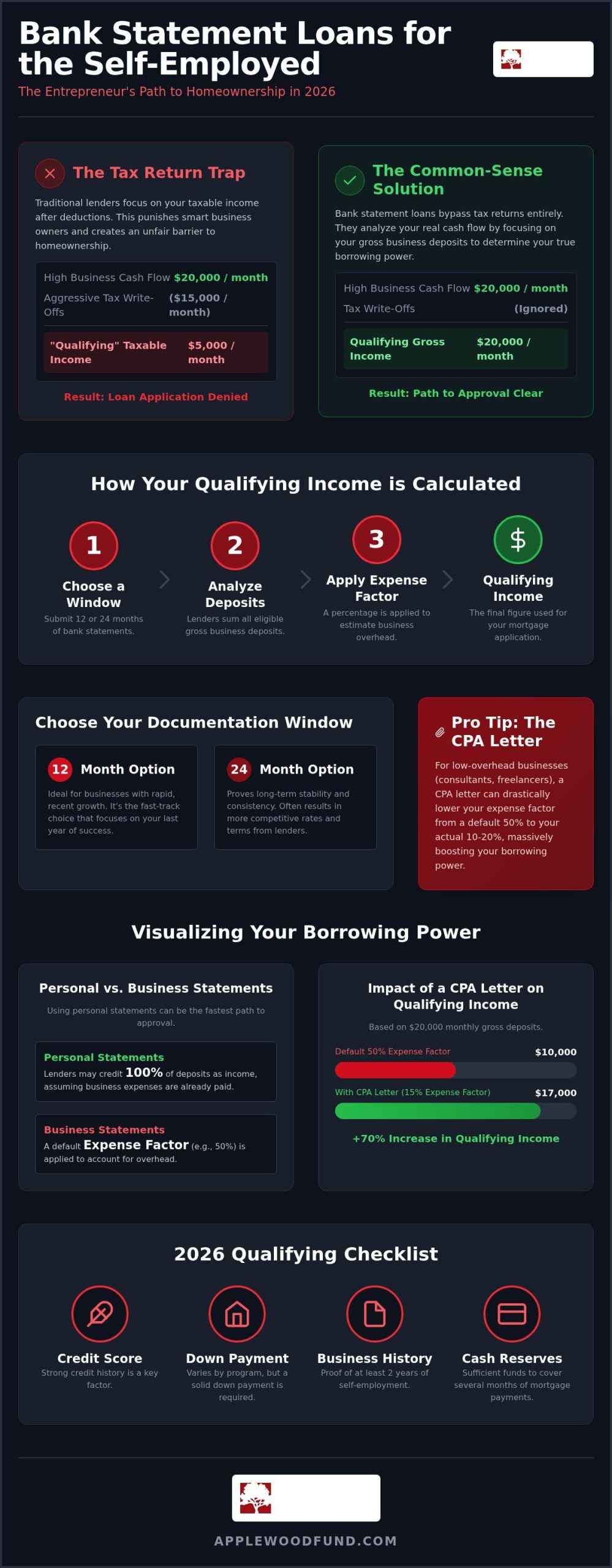
The “Tax Return Trap” is the primary reason self-employed borrowers face rejection. Standard lenders calculate your debt-to-income (DTI) ratio based on your net income after all business expenses and write-offs. This results in a skewed perspective. Your “taxable income” might look low on paper, even if your “actual cash flow” is robust enough to support a luxury home purchase. This disconnect creates an unfair barrier. Bank statement loans remove this hurdle by looking at the top line of your business health rather than the bottom line the IRS sees.
The 12-Month vs. 24-Month Statement Option
When you apply for bank statement loans for self employed individuals, you generally choose between two documentation windows. Understanding What is a Bank Statement in this context is vital; it is the primary evidence of your income stability.
- 12-Month Option: This is the fast-track choice. It’s ideal for businesses experiencing rapid growth or those that have recently pivoted to a more profitable model. Lenders average your deposits over the last year to find your qualifying income.
- 24-Month Option: This path offers a more comprehensive view of your business’s longevity. It often results in more competitive terms because it proves your income isn’t just a temporary spike.
Lenders apply an “expense factor” to these deposits to estimate your overhead. If you’re in a service-based industry with low costs, we can often use a lower expense factor to boost your qualifying power. It’s all about finding the math that works for your specific business structure.
How Bank Statement Loans Work: The Deposit Analysis
The math behind a bank statement loan is refreshingly direct. Lenders aren’t interested in your net profit after deductions. They want to see the heartbeat of your business through your monthly deposits. The process begins by totaling all eligible deposits over your chosen 12 or 24-month window. This total is then divided by the number of months to establish your “gross qualifying income.” It’s a transparent system that rewards your actual revenue rather than your tax strategy.
Consistency is the key to a fast approval. While your total volume matters, lenders look for a steady flow of capital. Large, one-time “lumpy” deposits might be scrutinized or excluded if they don’t reflect your typical business activity. Because these are Non-QM bank statement loans, the underwriting is flexible but focused on the reality of your cash flow. If you can show a reliable pattern of income, you’re already halfway to the closing table.
Personal vs. Business Bank Statements
You have two primary paths for documentation. Personal bank statements are often the “fast lane” for bank statement loans for self employed professionals. If you transfer your business income into a personal account, lenders may credit 100% of those deposits as income. They assume your business expenses were already covered before the money hit your personal stash. Business statements are different. If you use these, lenders typically apply a default “Expense Factor” to account for overhead. Your ownership percentage also plays a role. If you’re a 100% owner, every dollar counts. If you share ownership, only your specific portion of the deposits will be used for qualification.
The CPA Letter: Your Secret Weapon
Don’t let a default 50% expense ratio shrink your borrowing power. If you’re a consultant, writer, or digital nomad, your actual overhead is likely much lower. This is where a CPA letter becomes your greatest asset. A certified professional can provide a Profit and Loss (P&L) statement that proves your real-world expenses are only 10% or 20%. This simple document can dramatically boost your qualifying income. It’s the most effective way to lower the lender’s default expense factor and increase your loan amount. Whether you’re an S-Corp owner or a 1099 contractor, having your CPA verify your business structure ensures the lender sees the full strength of your financial position. If you’re ready to see how your numbers stack up, you can explore your options with a specialist who understands the entrepreneur’s journey.
Bank Statement Loans vs. Hard Money: Which is Right for You?
Choosing between these two funding paths isn’t about which product is “better” in a vacuum. It’s about your specific timeline and the property in your sights. If you’re looking for a permanent primary residence to raise a family, stability is your priority. If you’re looking to snatch a property off the market before a competitor does, speed is your only metric. Understanding the trade-offs between bank statement loans for self employed borrowers and private hard money is the first step to winning in the 2026 market.
Think of it this way: a bank statement loan is a marathon runner, while hard money is a sprinter. One is built for the long haul with lower costs; the other is built for immediate impact and rapid execution. Both allow you to bypass the traditional bank’s obsession with tax returns, but they serve very different masters. For a deeper look at how these two financing strategies compare on speed, cost, and closing power, explore this comprehensive breakdown of hard money vs traditional mortgage options in 2026.
Long-Term Stability with Bank Statement Mortgages
Bank statement loans for self employed professionals function much like a conventional mortgage once you’re through the door. You’re looking at 15 to 30-year terms. In 2026, most borrowers opt for fixed-rate stability to protect against market fluctuations. However, 5/1 or 7/1 Adjustable-Rate Mortgages (ARMs) remain popular for entrepreneurs who plan to scale their business and refinance or sell within a few years. The goal here is simple: build equity and secure a home without gutting your business’s capital or changing your tax strategy. These loans typically require a down payment between 10% and 20%, and they offer interest rates that are only slightly higher than traditional conforming loans.
Hard Money for Speed and Primary Residences
Hard money is the solution when time is your biggest enemy. While a bank statement loan might take a few weeks to fully underwrite, hard money can often close in a matter of days. This is private capital, and the approval is based primarily on the property’s value and your equity position. At Applewood Funding, we offer rare owner-occupied hard money solutions. Most private lenders won’t touch a primary residence due to regulatory complexity. We do. If you’re an Arizona homeowner wondering can I get a hard money loan on my home, our 2026 Arizona guide breaks down the equity requirements and federal income verification rules you need to know.
This strategy is perfect for winning competitive bids. You can make an offer that’s as strong as a cash bid, close the deal, and move in. Once you’ve secured the property, you can catch your breath. Many of our clients use hard money as a bridge. They buy the home fast, then transition into a long-term bank statement loan once the initial “sprint” is over. It’s about using the right tool for the right phase of your homeownership journey. Whether you need the 30-year safety net or the 10-day closing, we have the capital to make it happen.
Qualifying Checklist: What You Need to Apply in 2026
Qualifying for a mortgage shouldn’t feel like an interrogation. While big banks obsess over every line of your tax returns, alternative lenders focus on the big picture. In 2026, the criteria for bank statement loans for self employed professionals have become more accessible, provided you have the equity and the track record to back up your ambitions. Lenders use your down payment and credit history as a security blanket; the more you bring to the table, the more flexible they become with the rest of the file.
You don’t need a perfect history to win. We look for stability and common sense. Here is the baseline of what you’ll need to move forward:
- Business Longevity: You generally need two years of self-employment history in the same industry. This proves your income isn’t a fluke.
- Credit Score: A FICO score of 640 is the typical floor. If you’re aiming for a lower down payment, a 680 or higher is your ticket to better terms.
- The “Seasoning” Rule: Alternative lending is built for real life. If you have a past bankruptcy or foreclosure, you can often qualify just two years after the event.
- Liquid Reserves: Lenders want to see that you have a few months of mortgage payments tucked away in savings after the deal closes.
The Essential Documentation Bundle
Preparation is the difference between a 10-day closing and a 30-day headache. You’ll need 12 or 24 months of full, unaltered bank statements. Don’t just send the summary pages; underwriters need every page to verify the flow of funds. You’ll also need a valid business license or a consistent history of 1099s to prove your business is active and legal. If your income is “lumpy”-meaning you have huge months followed by quiet ones-don’t panic. Underwriters average these out over the 12 or 24-month period to find a stable monthly figure they can use for your qualification.
Credit and LTV Benchmarks
Your Loan-to-Value (LTV) ratio is the most important number in your file. For most bank statement loans for self employed borrowers, the maximum LTV is 90%, meaning you need a 10% down payment. However, hitting that 90% mark usually requires a credit score of 680 or higher. If your score is in the 640 range, expect to put 20% down. This equity protects the lender and proves you’re committed to the property. It’s a simple trade-off: more skin in the game equals more flexibility on the paperwork. Stop waiting for a “maybe” from a traditional bank and apply for your bank statement loan today to get a definitive answer on your buying power.
Secure Your Funding with Applewood Funding Inc
Big banks move at a glacial pace. Your business doesn’t. You need a lender that matches your energy and respects your time. Applewood Funding Inc provides direct access to private capital without the typical corporate runaround. We don’t have a distant board of directors to consult; we have decision-makers who understand the grit it takes to be an entrepreneur. We specialize in bank statement loans for self employed professionals because we know your tax return only tells half the story. Your bank statements tell the truth about your success.
We’ve built our reputation on moving at the speed of your business. Whether you’re looking to secure a primary residence or expand your portfolio, we have the specialized expertise to handle complex scenarios. We don’t hide behind automated rejection letters. We look for reasons to fund your dream, not excuses to delay it. Our national reach means we can help you win in any market, providing a personalized, high-energy approach that traditional institutions simply can’t replicate.
The Applewood Advantage: Solutions, Not Excuses
Traditional lenders find reasons to say “no.” We find ways to say “yes.” We specialize in the complex self-employed scenarios that make big banks nervous. If you have high write-offs or multiple business entities, we know how to navigate the paperwork to show your true qualifying power. We look at the whole picture. Your credit score is a piece of the puzzle, but your cash flow is the foundation.
Our team handles owner-occupied hard money when others won’t. This is a rare and powerful tool for entrepreneurs who need to move fast. We’re committed to transparent communication. You’ll never wonder where your file stands. You’ll get straight answers and fast updates. We’re your ally in a lending world that often feels like an adversary. We don’t just provide loans; we provide the capital that fuels your next chapter. To ensure that chapter remains secure, you can discover Hako Risk Advisors for expert guidance on commercial insurance and risk management.
Bureaucracy is the enemy of progress. We’ve stripped away the red tape to create a streamlined path to homeownership. When you work with Applewood, you’re consulting with a human expert, not a computer algorithm. You’ll get a real answer based on your actual financial strength. Our process is designed for the modern entrepreneur who values results over formalities.
Stop waiting for a “maybe” from a lender that doesn’t understand your business structure. Submit your statements and get a definitive answer on your buying power. We move as fast as you do. Your path to a new home starts with a single conversation. If you’re ready to move, get started with Applewood Funding today and experience the difference that direct private capital makes.
Claim Your Home with Confidence
You’ve built a business from the ground up. You’ve mastered your industry. Don’t let a traditional bank’s outdated rules stall your personal progress. Bank statement loans for self employed professionals are the key to unlocking the door to your new home without sacrificing your tax efficiency. By focusing on your actual deposits and leveraging specialized private capital, you can bypass the red tape and move at the speed of your own success. Applewood Funding Inc provides direct access to private lending experts and nationwide service for self-employed borrowers, ensuring you have a partner who understands your hustle. We specialize in owner-occupied alternative loans that others won’t touch. Your business is thriving; your home loan should too. It’s time to stop apologizing for your success and start leveraging your cash flow. Stop waiting on the bank; get your statement-based loan now. The real estate market won’t wait for your accountant to file next year’s returns. Neither should you. Secure the property you’ve earned with a partner who values results over bureaucracy.
Frequently Asked Questions
Can I get a bank statement loan with only 12 months of statements?
Yes, you can qualify with just 12 months of statements. This option is perfect for businesses experiencing rapid revenue growth or recent pivots. Lenders calculate your qualifying income by averaging the total deposits from this one-year window. While 24-month programs might offer slightly better terms due to the longer stability proof, the 12-month path is the fastest way to leverage your current momentum for a home purchase.
Do bank statement loans have higher interest rates than conventional loans?
Bank statement loans typically carry interest rates that are 0.50% to 1.50% higher than conventional mortgages. This is because they fall into the Non-QM category, which carries more risk for the lender. You’re paying for the flexibility to bypass tax returns. For many entrepreneurs, the ability to secure a home without changing their tax strategy far outweighs the slightly higher monthly interest cost.
What is the minimum credit score for a self-employed mortgage?
Most programs require a minimum credit score between 620 and 680. If you have a score of 680 or higher, you’ll unlock the most competitive terms and lower down payment requirements. For those with scores in the 640 range, you can still secure bank statement loans for self employed borrowers, but you should expect to bring a larger down payment to the closing table to offset the lender’s risk.
Can I use a bank statement loan for my primary residence?
Yes, these loans are designed specifically for your primary residence. While many private lenders only focus on investment properties, our programs cater to owner-occupied scenarios. You can use your business’s cash flow to buy the home where you’ll actually live. This eliminates the frustration of being a successful business owner who can’t qualify for a personal roof over their head because of legal tax write-offs. For those moving into managed communities, My Arizona HOA Manager provides the specialized financial management and accounting services necessary for a stable homeowner association.
Is a down payment higher for bank statement loans?
You should expect to put down at least 10% to 20% of the home’s purchase price. Traditional loans sometimes allow for 3% or 5% down, but bank statement programs require more equity to protect the lender. If your credit score is above 680, you can often qualify for the 10% down option. Equity is your greatest ally in the alternative lending market; it proves your commitment to the property.
Do I need a Profit and Loss statement if I have bank statements?
A Profit and Loss (P&L) statement isn’t always mandatory, but it’s a powerful tool. Without one, lenders often apply a default 50% expense factor to your business deposits. If your actual overhead is lower, a CPA-certified P&L can prove your real income is higher. This simple document can significantly increase your borrowing power by lowering the estimated costs of running your business.
How fast can a bank statement loan close compared to a traditional mortgage?
Bank statement loans often close much faster than traditional mortgages. While a big bank might take 45 to 60 days to navigate their bureaucracy, alternative lenders use streamlined underwriting to close in as little as 11 to 21 days. We move at the speed of your business. This rapid execution allows you to compete with cash buyers and win in tight real estate markets where timing is everything.
Can I qualify if I have been self-employed for less than two years?
A minimum of two years of self-employment history is generally required to qualify. Lenders need to see a consistent track record of income stability in the same industry. If you have been in business for slightly less than two years but have a long history in the same field, exceptions may exist. Consistency is the primary factor underwriters use when evaluating bank statement loans for self employed professionals to determine repayment ability.