


Bank Statement Loans: 2026 Guide for Self-Employed
September 1, 2026
Hard Money vs. Traditional Mortgage: Speed, Strategy, and Selection in 2026
September 2, 2026Bank Statement Loans for Investment Property: 2026 Guide

Your tax returns tell the IRS you’re broke, but your bank statements prove you’re ready to build an empire. For self-employed entrepreneurs in Phoenix and Scottsdale, heavy write-offs are a badge of smart business, yet they’re the primary reason big banks reject your mortgage applications. You’ve got the cash flow, the vision, and the opportunity. Traditional underwriting moves at a snail’s pace while your next deal slips away. It’s time to stop letting a tax document define your purchasing power.
Securing a bank statement loan for investment property allows you to qualify based on what you actually deposit, not what you show the government after deductions. Whether you’re targeting a rental in Mesa or a luxury flip in Sedona, you need a fast-moving ally that values your real-world income. This 2026 guide shows you exactly how to leverage 12 to 24 months of deposits to bypass traditional red tape. We’ll cover the latest LTV limits, credit requirements starting at 620, and the streamlined process to close deals before the competition even gets an appraisal. Learn how to scale your portfolio, secure fast funding, and finally outrun the bureaucracy of institutional banking.
Key Takeaways
- Stop letting tax write-offs kill your deals. Learn how to use your actual revenue to qualify for a bank statement loan for investment property rather than relying on net income.
- Discover why 12 to 24 months of bank statements provide a more accurate picture of your purchasing power than a traditional W2 ever could.
- Gain a competitive edge in fast-moving Arizona markets like Phoenix and Scottsdale by securing funding that closes in days, not weeks.
- Master the “seasoning” rules and credit requirements needed to scale your rental portfolio without the red tape of institutional banks.
- Prepare your application for a seamless approval by understanding exactly how lenders analyze your business and personal deposits.
Why Traditional Mortgages Fail Self-Employed Investors
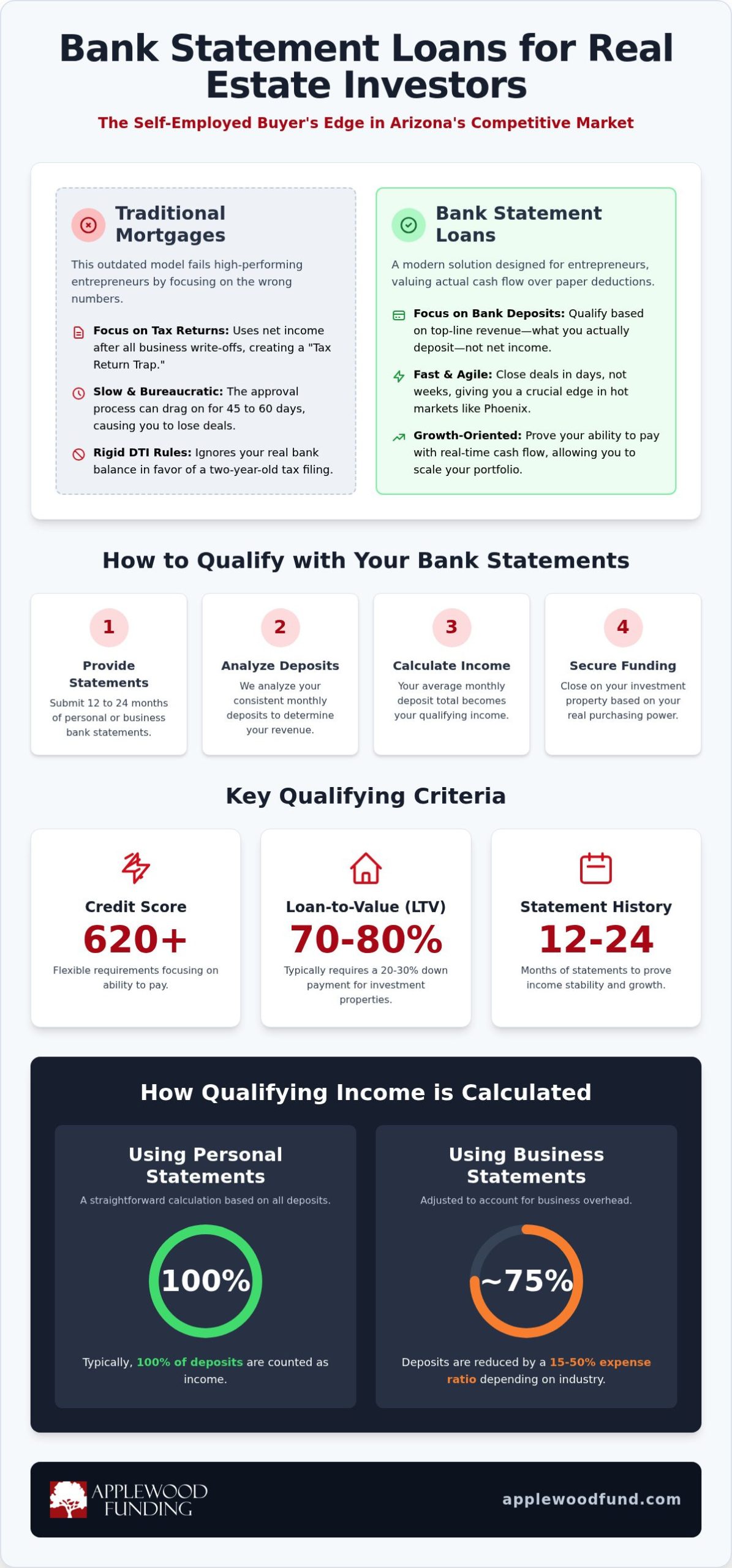
Traditional banks operate on a rigid, outdated playbook. They demand tax returns that show every deduction you’ve legally claimed. For an elite investor, those write-offs are smart business. To a big bank, they look like a lack of income. This is the “Tax Return Trap.” You have the cash flow to buy that Peoria rental, but the paperwork says otherwise. It’s a frustrating cycle that keeps high-performing entrepreneurs on the sidelines while W2 employees snatch up prime real estate.
A bank statement loan for investment property flips the script. Instead of looking at your net income after the IRS takes its cut, lenders look at your top-line revenue. A bank statement serves as the primary evidence of your ability to repay. It shows the real-time health of your business. In a 2026 Arizona market where inventory moves fast, you can’t afford to wait for a traditional underwriter to “discover” your income. You need a solution that recognizes your actual purchasing power.
The Problem with Debt-to-Income (DTI) Ratios
Qualified Mortgages were built for people with steady paychecks and simple lives. Business owners don’t fit that mold. When you write off equipment, travel, or marketing, your taxable income drops. Traditional DTI calculations use that lower number. With the national average 30-year fixed mortgage APR at 6.82% in September 2026, qualifying is already a challenge. Paper losses shouldn’t be the reason you lose a deal in Tempe or Mesa. Institutional lenders often ignore the reality of your bank balance in favor of a two-year-old tax filing.
Bank Statement Loans as a Strategic Investment Tool
Stop viewing alternative lending as a backup plan. It’s a growth strategy. By using a bank statement loan for investment property, you bypass the intrusive tax disclosure process. You prove your repayment ability through consistent monthly deposits. This approach allows you to scale your rental portfolio rapidly. You don’t have to wait for your next tax filing to show “better” numbers. You act when the market is right.
Speed is your greatest asset. Traditional loans can drag on for 45 to 60 days. In hot markets like Scottsdale or Phoenix, that’s an eternity. Alternative lenders like Applewood Funding, managed by Joel McDaniel (NMLS 175371), prioritize results over bureaucracy. We understand that local entrepreneurs need agile partners. You get a clear answer fast. You secure the property. You move on to the next investment. It’s about keeping your momentum in a competitive landscape.
How Bank Statement Loans Work for Investment Property
The process is simple. We look at what you make, not what you keep after legal deductions. While a big bank gets lost in your tax schedules, we focus on your monthly deposits. This is the core of a bank statement loan for investment property. We use these totals to calculate a monthly average. That average becomes your “qualifying income.” It’s a transparent, common-sense approach that respects the reality of being a business owner.
You can use personal or business bank statements for this process. If you use personal statements, we typically count 100% of the deposits as income. Business statements are handled differently. We apply an expense ratio to account for overhead. This usually ranges from 15% to 50% depending on your industry. A consultant has lower overhead than a retail shop, so we adjust to fit your specific business model. We don’t believe in one-size-fits-all underwriting.
The Math Behind the Approval
Lenders typically look at 12 or 24 months of history. Why choose 24? It often leads to better pricing because it shows long-term stability. If your income is growing fast, 12 months might reflect your current purchasing power better. We analyze every line item to build a clear picture. If you co-mingle funds by paying business bills from a personal account, we’ll need to see the logic. We want to understand your cash flow, not just your balance.
Large deposits require a paper trail. If you receive a $50,000 transfer that isn’t from your normal operations, we’ll ask for proof of the source. We want to ensure your income is consistent and reliable. This isn’t about finding reasons to say “no.” It’s about building a file that proves you can handle the debt. With credit score requirements starting as low as 620, the focus remains on your ability to pay rather than a perfect tax return.
Eligible Properties and Occupancy Rules
Investment properties carry different risks than primary homes. Because of this, LTV limits usually sit between 70% and 80%. You’ll likely need a down payment of 15% to 25% for most Arizona properties. This program isn’t limited to single-family rentals. You can use these loans for various property types:
- Single-Family Residences: Perfect for long-term rentals in Peoria or Glendale.
- Multi-Family Units: Secure 2 to 4 unit buildings in Phoenix to maximize your doors.
- Condos: Target high-demand units in Scottsdale or Tempe.
- Equestrian Estates: Ideal for properties in Scottsdale’s premier horse communities, supported by organizations like We LOVE Arabian Horses that promote the welfare and appreciation of these iconic animals.
The strategy is entirely up to you. Whether you’re eyeing a long-term rental or a high-yield AirBnB in Sedona, the income verification remains the same. Short-term rentals are a massive part of the Arizona market, and we understand how that cash flow works. If you’re ready to see how your deposits stack up against your next property goal, reach out to Joel McDaniel (NMLS 175371) to get a clear, expert picture of your numbers.
Qualifying Criteria: 12 vs. 24 Months of Statements
Qualification starts with the “seasoning” rule. To secure a bank statement loan for investment property, you typically need to prove you’ve been self-employed in the same industry for at least two years. This isn’t about looking at your tax returns. It’s about establishing that your business is a stable, income-generating entity. While traditional banks get hung up on your net income after deductions, we focus on the consistency of your deposits over that two-year period.
Your credit score sets the stage for your terms. A score between 640 and 660 is the typical baseline for most programs in 2026, though options exist for scores as low as 620. For investment properties in Arizona, expect a down payment requirement between 15% and 25%. Lenders also want to see liquid reserves. You’ll likely need enough cash in the bank to cover three to six months of mortgage payments, taxes, and insurance. This safety net ensures you can handle a temporary vacancy in your Phoenix or Tucson rental without breaking a sweat.
Choosing the Right Statement Window
Deciding between 12 and 24 months of statements depends on your recent business trajectory. If your revenue spiked in 2025 and you’re currently having your best year ever, the 12-month program is your best bet. It captures your most recent scaling and maximizes your qualifying income. It’s the go-to choice for fast-growing entrepreneurs in Scottsdale who need their current success reflected in their purchasing power.
The 24-month program is the gold standard for established businesses. By providing a longer history, you prove long-term stability, which often unlocks the lowest possible interest rates. In some cases, your lender might request a simple Profit and Loss (P&L) statement prepared by a CPA. This isn’t a deep dive into your taxes. It’s just a way to verify that your business overhead aligns with industry standards, ensuring the loan is a win for your portfolio.
Asset-Based Lending Nuances
Your Loan-to-Value (LTV) ratio is directly tied to your credit history. If you have a score above 720, you can often push your LTV higher, meaning a smaller down payment. If you’ve dealt with a bankruptcy or foreclosure in the past, don’t assume you’re disqualified. Most bank statement programs only require a two-to-four-year waiting period before you’re eligible to invest again. We look for a clean history since that event, not a perfect record from a decade ago.
Applewood Funding, managed by Joel McDaniel (NMLS 175371), takes a “whole picture” approach to every deal. We don’t just look at a credit score and a stack of papers. We look at the strength of the property in markets like Sedona or Flagstaff and the reality of your cash flow. If the deal makes sense and the bank statements show you’re a high-performer, we find a way to get it closed. You’re an investor, not a file number, and your financing should reflect that.
Strategic Advantages for Arizona Real Estate Portfolios
In the high-stakes Arizona market, speed is your greatest weapon. If you’re bidding on a property in Phoenix or Scottsdale, a traditional bank’s 60-day timeline is a liability. Savvy entrepreneurs use a bank statement loan for investment property to close deals while others are still hunting for old W2s. In 2026, where the national average 30-year fixed mortgage APR sits at 6.82%, the cost of capital is stable, but the cost of waiting is high. You keep your tax deductions, maintain your cash flow, and secure the asset before the competition even gets an appraisal.
Leveraging equity is the fastest way to grow your empire. Many Scottsdale investors are sitting on massive amounts of untapped equity in their current portfolios. A bank statement cash-out refinance lets you pull that capital out without the IRS-driven scrutiny of a big bank. Use that liquidity to fund a new short-term rental in Sedona or a multi-family project in Mesa. It’s about velocity. You’re moving from one-off flips to a sustainable, long-term rental empire while keeping your tax strategy intact.
Navigating the Arizona Real Estate Market
Arizona’s geography offers diverse opportunities, from high-altitude spec builds in Flagstaff to luxury desert vacation rentals. When you’re transitioning between properties, bridge lending provides the necessary gap coverage to keep your momentum. If you need to secure a home for yourself while your business capital is tied up in investments, consider Owner Occupied Hard Money Loans for a fast, reliable solution. We understand the local landscape from Tucson to Peoria.
Scaling with Non-QM Solutions
Traditional financing has a hard ceiling. Once you hit the 10-loan limit imposed by Fannie Mae or Freddie Mac, institutional banks shut the door. We don’t. Non-QM solutions allow you to scale your portfolio as large as your vision. By combining bank statement verification with DSCR (Debt Service Coverage Ratio) options, you can qualify based on a property’s potential income. This is why Scottsdale entrepreneurs prefer our speed. We focus on the deal’s merit and your actual deposits, not a restrictive federal limit.
Ready to break through the 10-loan limit and dominate the Phoenix market? Speak with Joel McDaniel (NMLS 175371) today to map out your 2026 scaling strategy and lock in your next Arizona investment.
Securing Your Investment Property with Applewood Funding
Big banks see your business deductions as a problem. We see them as a sign of a successful entrepreneur. At Applewood Funding, we’ve stripped away the institutional bureaucracy to provide a bank statement loan for investment property that actually works for your lifestyle. You don’t need a tax return to prove your worth. You need a partner who understands the Phoenix and Scottsdale markets. Managed by Joel McDaniel (NMLS 175371), our team is built on speed, local expertise, and a commitment to closing deals that others leave behind.
Preparation is the key to a seamless experience. When you work with a local Arizona expert, you get a direct line to decision-makers. No impersonal portals or offshore underwriting. We analyze your deposits to find the maximum purchasing power hidden in your cash flow. Whether you are targeting a luxury condo in Scottsdale or a multi-family unit in Tempe, we move at the speed of the market. Our goal is simple. We close in days, not months. You get the results you need to keep your portfolio growing without the typical mortgage headaches.
The 3-Step Approval Process
We’ve streamlined the path to funding into three clear stages. It’s designed to get you from application to keys without the stress of a traditional bank. We prioritize clarity and communication at every turn.
- Step 1: Cash Flow Analysis: We review 12 or 24 months of your bank statements. There are no tax returns required. We calculate your qualifying income based on your real-world deposits and business revenue.
- Step 2: Property and Equity Review: We conduct a rapid appraisal and review the equity in the deal. We focus on the asset’s value in the current Arizona landscape, from Sedona to Flagstaff.
- Step 3: Rapid Funding: Once the numbers align, we move to closing. You get the capital you need to secure the property before your competition can even schedule an appointment.
During the final closing stages, ensuring your legal documents are handled with precision is vital; for investors managing out-of-state entities or international paperwork, Sacramento Notary Co allows you to explore Apostille Service to ensure every signature is properly authenticated.
Get Started Today
Don’t let another prime investment opportunity in Mesa or Sedona slip away while you wait on a big bank. To get a “Quick Quote” for your next project, have your 12 or 24 months of most recent bank statements and a valid ID ready. We’ll handle the heavy lifting of the analysis. We are ready to help you scale your portfolio across Peoria, Glendale, and Tucson. Our team understands the urgency of the 2026 market. Ready to scale? Apply for your Bank Statement Loan now!
Build Your Arizona Real Estate Empire Today
The days of letting tax write-offs dictate your purchasing power are over. You have the cash flow, the business success, and the local market vision to dominate in Phoenix and Scottsdale. A bank statement loan for investment property is the key to bypassing traditional red tape and moving at the speed of today’s market. By qualifying based on your actual deposits, you can secure high-value assets without the stress of institutional underwriting delays. You’ve built your business on your own terms. Your financing should work the same way.
Applewood Funding is your fast-moving ally in this journey. With expert guidance from Joel McDaniel (NMLS 175371), you’re not just getting a loan; you’re getting a local partner who knows the Arizona landscape. We specialize in fast-track funding that respects your time and rewards your entrepreneurial spirit. Don’t let another prime deal slip away while a big bank searches for a W2 that doesn’t exist. Take control of your portfolio and act while the opportunity is hot. We’re ready when you are.
Get Your Arizona Investment Property Funded—No Tax Returns Required!
Frequently Asked Questions
Can I get a bank statement loan for an investment property with 10% down?
Yes, 10% down is possible for exceptional borrowers, but most Arizona investors should plan for 15% to 25% down. Investment properties carry higher risk than primary residences, so lenders look for more skin in the game. Your credit score and the property’s potential cash flow play a huge role in the final LTV. We prioritize finding a structure that keeps your capital liquid while securing the asset.
Do bank statement loans have higher interest rates than conventional loans?
Expect interest rates for a bank statement loan for investment property to be roughly 0.50% to 1.50% higher than conventional rates. In September 2026, while conventional rates average around 6.82%, bank statement options typically land between 7.0% and 9.0%. You’re paying for the flexibility and the ability to bypass tax return scrutiny. Most investors find the speed and easier qualification far outweigh the slightly higher monthly cost.
How do I qualify for a bank statement mortgage if I am 1099?
Qualifying as a 1099 contractor is straightforward. We analyze 12 to 24 months of your bank statements to track your gross deposits. Instead of looking at your net income after deductions, we use your average monthly revenue to determine your purchasing power. This method is perfect for freelancers and consultants in Scottsdale or Phoenix who have significant business expenses that traditionally lower their taxable income on paper.
Is there a limit to how many investment properties I can own with these loans?
No hard limit exists like the 10-loan cap found in traditional Fannie Mae or Freddie Mac financing. These are Non-QM solutions, meaning they aren’t bound by restrictive federal portfolio limits. You can continue to scale your rental empire across Mesa, Tempe, and Glendale as long as your bank statements prove you can handle the debt. This flexibility is exactly why high-growth investors choose alternative lending over big banks.
Can I use business bank statements if I am only a 25% owner?
You can use business statements, but the lender will only credit you for your percentage of ownership. If you own 25% of the company, we’ll typically count 25% of the qualifying deposits as your personal income. You’ll also need to provide a letter from your CPA or the other owners confirming your access to those funds. It’s a common scenario for partners in Arizona startups or real estate syndications.
What is the minimum credit score for an Arizona bank statement loan?
The minimum credit score required is 620. While a higher score often unlocks better interest rates and lower down payment requirements, we have options for investors who have faced recent financial hurdles. We look at the strength of your current cash flow and the property’s value in markets like Sedona or Flagstaff. Your recent bank statement history carries more weight than a mistake from several years ago.
How long does the approval process take with Applewood Funding?
We close deals in days, not months. While a traditional bank might take 45 to 60 days to navigate their bureaucracy, our streamlined process focuses on speed. Managed by Joel McDaniel (NMLS 175371), our team performs a rapid cash flow analysis and moves straight to appraisal. In the fast-moving Phoenix real estate market, this agility ensures you don’t lose your property to a cash buyer while waiting for paperwork.
Do I need to provide tax returns if I have a high credit score?
You never have to provide tax returns for this program, regardless of your credit score. The entire purpose of a bank statement loan for investment property is to qualify based on deposits rather than IRS filings. Even if you have a perfect 800 score, we’ll still use your bank statements to verify income. This protects your privacy and allows you to maintain your aggressive tax deduction strategy while still scaling your portfolio.