

Avoiding foreclosure with a private loan in Mesa through repayment plans
November 16, 2026How to scale a Mesa flipping business with private money
More deals don’t automatically mean a stronger flipping business; reliable capital and cash reserves do. For investors asking how to scale a flipping business with private money in Mesa, a practical starting point is building relationships with 2-3 hard-money lenders and combining funding sources carefully. Put loan terms in writing, budget for renovation overruns, and keep at least six months of carrying costs in reserve.
You don’t need an all-cash offer to flip a house. Financing can help you pursue projects while keeping cash available for renovations and carrying costs. A plan for how to scale a flipping business with private money in Mesa should match funding to each deal and account for expenses that continue during construction. This guide covers deal preparation, financing options, project controls, and cash-flow planning as you take on more properties.
Key Takeaways
- Prepare a clear deal package with the purchase plan, renovation scope, and exit strategy to make funding conversations more focused.
- Match each financing source to its role in the project, and document private-money terms before funds are committed.
- Stress-test the deal for repair overruns and a slower sale; the purchase price and projected resale value shape how much risk the project can absorb.
- Track interest, insurance, taxes, utilities, and other holding costs in your cash-flow plan so delays don’t catch your business off guard.
- Build a repeatable lender pipeline and stagger project starts to grow without stretching your cash or renovation capacity too thin.
1. How do you secure funding for flipping projects?
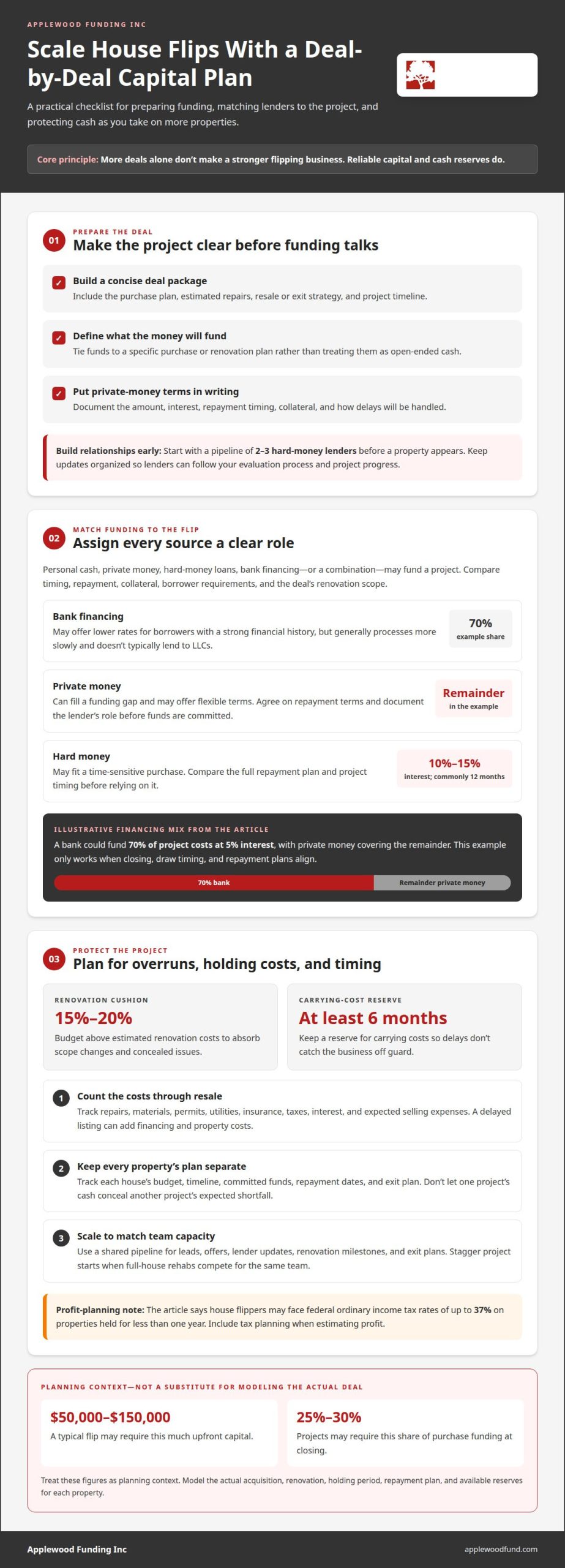
Private money for a Mesa house flip comes from an individual investor who provides project capital under agreed repayment terms. Put the amount, interest, repayment timing, collateral, and process for handling delays in a written agreement. Tie the funds to a defined purchase or renovation plan rather than treating them as open-ended cash. Clear terms help both sides understand the project before work begins.
Build lender relationships before a property appears in your search. Prepare a concise deal package with the purchase plan, estimated repairs, resale strategy, and timeline. Keep project updates organized so a lender can understand how you evaluate houses and assess future opportunities. Compare potential financing based on project scope, repayment terms, and timing. A record of completed work and clear communication can make future funding discussions more concrete.
Flipping projects can be funded with personal cash, private money, hard-money loans, bank financing, or a combination. The right mix depends on the acquisition, renovation scope, available reserves, and repayment plan. A typical flip may require $50,000 to $150,000 in upfront capital, and projects may require 25% to 30% of purchase funding at closing. Treat those figures as planning context, then model the actual deal. According to the Internal Revenue Service, house flippers may face federal ordinary income tax rates of up to 37% on properties held for less than one year. Include tax planning when estimating profit.
Funding multiple flips requires separating each property’s budget, timeline, and repayment plan. Don’t let one project’s available cash cover another project’s expected shortfall without tracking the effect. Set up a shared pipeline for leads, offers, lender updates, renovation milestones, and exit plans. Assign a project manager to coordinate contractors and schedules; a forum participant described three projects as a potentially safe workload for one manager, while noting that scope and timing matter. Stagger start dates when full-house rehabs compete for the same team.
Make deal review repeatable before you submit an offer. Confirm the purchase assumptions, map repairs by phase, and estimate the holding period. Match the funding source to the project, and document the terms before closing. Track committed funds and repayment dates separately for each house. This helps you decide whether another Mesa flip fits your workload and available capital, rather than relying on projected sale profits to cover current obligations.
2. Laddering bank, private, and hard-money financing
Private loans, bank financing, and hard money serve different roles in an Arizona flip. Private lenders may offer flexible terms, while hard-money loans commonly carry 10%-15% interest and a 12-month term. Banks may offer lower rates based on financial history, but generally process loans more slowly and don’t typically lend to LLCs. Compare timing, repayment, collateral, and borrower requirements before selecting a funding mix.
Laddering means assigning each source a clear share of the project, rather than relying on one lender for every cost. For example, a bank could fund 70% of project costs at a 5% interest rate, with private money covering the remainder. That structure can preserve cash for reserves, but only works if the closing schedule, draw timing, and repayment plans align. Put each lender’s amount and role in the project budget.
A cash offer may simplify a transaction for a seller, but it isn’t the only way to buy a flip. Financing can support an acquisition while leaving some cash available for contractors, repairs, and carrying costs. Hard money may fit a time-sensitive purchase, while bank financing may suit borrowers with a strong financial history and a longer closing window. Private money can fill a funding gap when both sides agree to documented terms. Applewood Funding is a private hard money lender offering Fix and Flip Loans in Arizona.
Private lending and real estate investment loans in Arizona are subject to applicable state and federal laws. Requirements can depend on the loan structure, borrower, collateral, and lending arrangement. Document the terms clearly and account for the details relevant to your transaction.
Calculate each Mesa flip from acquisition through resale. Start with the purchase price and closing costs, then include contractor bids, materials, permits, utilities, insurance, taxes, interest, and expected selling expenses. Estimate the holding period realistically: a delayed listing can add financing and property costs. Keep projected resale proceeds separate from project spending, then compare the remaining margin with your required profit before making an offer.
For LLC financing, confirm which borrower will sign, which property secures the loan, and how funds move through the business. Banks don’t typically lend to LLCs, so private or hard-money financing may be part of the plan. Keep separate records for each property. Include the contractor’s license information, invoices, draw dates, and lender payments in the project file. Clean records make growing operations easier to manage.
Use your figures to test the financing structure, not to assume a return. Compare the financing expense with expected resale proceeds after acquisition, repairs, holding, and selling costs. Before closing, make sure repayment does not depend on optimistic timing alone. A clear funding plan keeps each scaling decision tied to the deal’s actual cash needs.
3. Risks of unexpected renovation costs and market downturns
An unexpected repair can erase a flip’s projected margin before the first listing goes live. Budget 15%-20% above estimated renovation costs to absorb scope changes and concealed issues. Market conditions add another risk: house-flipping returns in recent years have fallen below 30%. Market activity and returns can fluctuate, so treat broad trends as context rather than a forecast for Mesa. Treat those figures as a reason to stress-test each deal, not as a forecast for Mesa.
In Mesa, renovation costs depend on the work scope, materials, and schedule, while permit requirements depend on the work and applicable local rules. Before acquisition, itemize labor, materials, likely repairs, and permit-related tasks in the project budget. Ask contractors to separate essential repairs from upgrades, then compare each line with the property’s resale plan. This gives you a clearer view of your financial exposure before committing hard-money funds.
Analyze the target neighborhood, not just Mesa’s overall market. Compare nearby listings with recently sold homes that match the property’s size, condition, and features. Note whether competing houses have updated kitchens, new roofs, or unfinished repairs, then estimate how your renovation plan will position the property. A home needing cosmetic work calls for a different budget and schedule than a full-house rehab.
Review market activity regularly. Track new listings, price changes, days on market, and completed sales in the neighborhoods where you plan to buy. Watch for changes that could affect your exit plan, such as more competing inventory or lower asking prices. Don’t treat one listing as proof of value. Compare several similar properties and update your resale assumptions before approving another acquisition.
Market the finished property around the improvements buyers can see and use. Before renovations begin, identify the likely buyer and prioritize features that fit comparable Mesa sales. Keep dated photos and invoices for completed work, then use accurate descriptions and clear images in the listing. If market conditions shift during construction, review competing listings and adjust your asking strategy to reflect current evidence rather than your original resale estimate.
As you scale, review each project at key milestones: after inspection, when demolition reveals hidden conditions, and before listing. Record revised costs, remaining work, and projected sale proceeds in one project tracker. If problems arise on two renovations at once, prioritize repairs by safety, function, and resale impact. This makes the business less dependent on optimism and helps protect cash when prices or timelines move against your plan.
4. Cash-flow reserves and carrying costs
Set a reserve target before opening another Mesa project. A house-flipping guide recommends keeping at least six months of carrying costs in reserve. Estimate monthly interest, property taxes, insurance, utilities, and any association charges, then multiply the total by six. Recalculate when a project’s schedule changes. This reserve is for ongoing ownership costs, not renovation surprises or the next acquisition.
Divide cash into clear operating categories: carrying costs, repairs, and business expenses. If a contractor’s invoice arrives before a scheduled loan draw or property sale, the carrying-cost reserve remains available for its intended purpose. Review each project’s cash position weekly and record expected payments against their due dates. This routine makes overlapping real estate projects easier to manage.
Build reserves from completed deals instead of treating all sale proceeds as spendable profit. One guide recommends allocating 20% of house-flipping profits to emergency reserves. Apply that percentage after calculating project results, then move the amount into a separate reserve account. Track the allocation by property and retain a record of the transfer. A competitive acquisition can wait; a reserve shortfall during construction can affect several active projects at once.
Carrying costs continue while a property is being renovated, listed, or awaiting closing. For each Mesa flip, track the planned completion date alongside the loan payment schedule and expected sale timeline. If a listing remains active longer than expected, update the forecast immediately. Add the extra period’s interest, utilities, insurance, and taxes to your cash-flow plan. You can then see how one house’s delay could affect the reserves available for another.
Use a weekly cash report to spot pressure early. Include opening cash, incoming funds, contractor payments, loan obligations, and the projected balance after each transaction. Reconcile invoices and bank activity against the report. Keeping this routine consistent helps you maintain current records across multiple projects as the business grows.
Review lender terms and reserve levels together before committing to another property. A repayment schedule affects how much cash remains available during a longer renovation or sale period. Compare the proposed timeline with existing portfolio obligations, then identify which reserve will cover each expense. If one house must sell to pay another project’s bills, map that dependency clearly. A reserve policy makes cash-flow decisions repeatable instead of last-minute guesses.
5. Finding private-money lenders
Private money for a Mesa flip may come from friends, family, or other real estate investors. Identify people who understand property investment and may have capital available. Explain the specific project, how the funds will be used, and the planned repayment source. A direct, deal-focused discussion gives potential lenders a clear basis for deciding whether the opportunity fits their goals.
Build connections before a closing deadline creates pressure. Attend local real estate investor meetups, discuss projects with experienced investors, and stay in touch with people interested in property deals. Contractors and real estate professionals may also know active investors. Treat an introduction as the beginning of a relationship, not an immediate request for money. Follow up with concise project updates and a clear next step.
Prepare a lender packet for each opportunity. Include the Mesa property address, purchase plan, renovation scope, estimated timeline, expected exit, and project budget. Add relevant experience and explain how you plan to use the funds. Keep details consistent across conversations. If an investor asks how a delay could affect repayment, show the timeline and cash-flow assumptions instead of relying on a verbal estimate.
Discuss capacity and timing early. An investor may be willing to participate but not have funds available when your acquisition is ready to close, so align the funding schedule with the project calendar. Clarify whether they are considering one deal or an ongoing series. Treat private capital as uncommitted until the terms and timing are documented.
A single funding relationship can still leave a business exposed. One investor described a lender pausing new lending after previously lending to 12 investors. The practical lesson is to maintain more than one active conversation and avoid building a pipeline around one person’s capital. Keep track of each lender’s preferred deal size, property type, timing, and communication style. That record helps you identify suitable matches as opportunities arise.
Use a lender tracker with the contact date, project discussed, requested documents, follow-up date, and current status. Update it after every conversation, including when a lender declines or can’t meet your timeline. Over time, you’ll see which investors are interested in Mesa flips and what information they need to evaluate a deal. Organized records and consistent communication make raising capital a repeatable part of business development.
To discuss financing for a real estate project, connect with a financing specialist about your project needs.
Applewood Funding: Fix and Flip Loans
Applewood Funding Inc. offers Fix and Flip Loans for investors financing property acquisition and renovation in Arizona, including Mesa. When you have a deal to evaluate, prepare the purchase plan, renovation scope, budget, and resale strategy to discuss financing. Applewood Funding Inc. is a private hard money lender, with No Credit Required, No Up-Front Fees, and No Cost to Apply.
Before moving forward, organize the details that shape your funding needs: the property, work plan, timeline, and expected exit. This makes it easier to discuss how financing fits alongside your reserves and other capital. For a different property plan, Applewood Funding Inc. also offers Rental Property Loans, Construction and Land Loans, and Owner Occupied Hard Money Loans.
Contact Applewood Funding Inc. to discuss financing for your flipping project.
Make your next Mesa deal a deliberate step forward
Scaling works best when each new acquisition strengthens the business instead of stretching it. A practical next step is to define what growth should improve, such as deal selection, project oversight, or financing coordination. Then map how to scale a flipping business with private money in Mesa around the capacity and priorities of your operation.
Applewood Funding offers Owner Occupied Hard Money Loans, Fix and Flip Loans, and Rental Property Loans. As you refine how to scale a flipping business with private money in Mesa, consider whether a financing option fits the property and your investment plan. Bring your project details and goals into the conversation, then decide on a path for your next move.
Contact Applewood Funding today to discuss your project and explore financing options. Keep building with a clear plan, one well-managed opportunity at a time.
Frequently Asked Questions
Do I Need to Have a Cash Offer to Flip a House?
No. A Mesa flipper can use financing instead of making an all-cash offer. Match the funding timeline to the seller’s closing schedule, and prepare a clear plan for the purchase and renovation. Before submitting an offer, identify which funds are available for closing and which are reserved for the work. This helps prevent an acquisition from consuming cash needed to keep the project moving.
How do you secure funding for flipping projects?
Present a specific property and a clear plan for using and repaying the funds. For a Mesa deal, organize the purchase details, repair priorities, expected timeline, and exit strategy before discussing financing. Separate committed funds from amounts still under consideration. When several projects are active, that distinction matters: an informal expression of interest is not the same as capital ready for closing.
What are common challenges with flipping?
Common challenges include hidden defects, contractor delays, changing buyer demand, and costs that continue before resale. For example, water damage uncovered after demolition can change the work sequence and delay listing preparation. Use written change approvals, updated schedules, and milestone reviews to understand the effect on your project. If the revised plan no longer supports the expected exit, reassess before committing more capital.
How can a Mesa house flipper find and vet private lenders?
Start with your real estate network, including local investors and people familiar with property projects. Before relying on a potential lender, clarify the source and timing of funds, decision process, collateral expectations, and repayment terms. Review proposed documents for consistency with prior discussions. A lender’s interest alone does not mean funding will be ready for your acquisition, so align the commitment with the closing schedule.
How can a flipper structure a deal and investor agreement to raise private money?
Set out the deal’s key terms in a written agreement before funds move. Specify the amount contributed, intended use, repayment source and timing, interest, collateral, reporting expectations, and how delays or changes will be handled. State whether repayment depends on sale proceeds or another agreed source. Keep investor terms separate from contractor agreements, and make sure the project budget reflects the full financing obligation.
What are the risks of scaling a fix-and-flip business with private money, and how can they be managed?
Scaling can concentrate risk across projects when they depend on the same lender, contractor, or resale window. A delay on one Mesa property may compete with another project’s cash needs. Track each deal’s obligations separately, set a limit on the simultaneous work your team can manage, and define when to pause new acquisitions if schedules or funding shift. Review the portfolio’s exposure before committing to another property.