

Peoria AZ hard money lenders and local loan options
November 1, 2026Glendale AZ Private Money Lenders and Loan Timelines
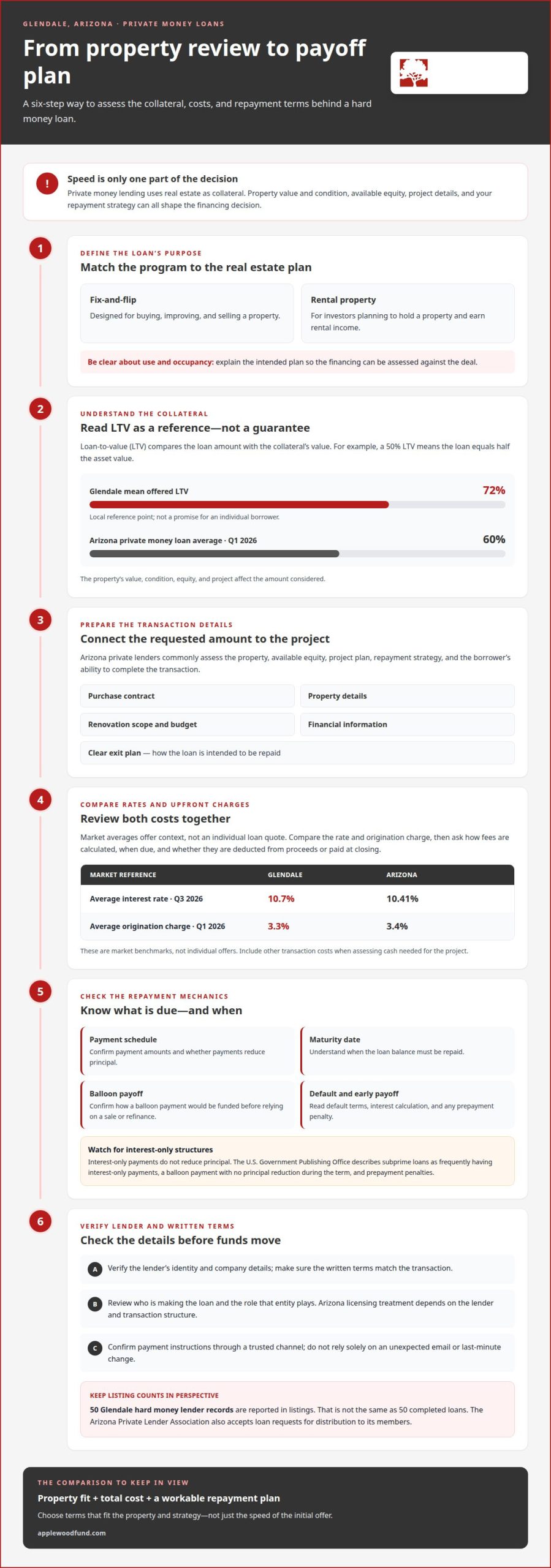
Hard money can move a real estate deal forward, but speed alone doesn’t make it the right loan. Glendale, AZ private money lenders assess the property, available equity, project, and repayment plan; the mean loan-to-value ratio offered for Glendale hard money loans is 72%. That figure is a local reference point, not a promise of what any one borrower will receive.
It’s smart to look beyond the advertised timeline. Rates, fees, approval, and closing can all affect whether a loan fits your purchase or project, and the details depend on the deal. A clear picture of the costs and steps can help you move with confidence instead of rushing into terms that don’t work.
Here, you’ll learn how private hard-money loans are structured, what shapes the terms, and which parts of the process can affect approval and closing. You’ll also find practical ways to compare Glendale lender listings, including the collateral, repayment structure, and fit with your real estate plans. Applewood Funding offers owner-occupied loans, and owner-occupied homes are OK.
Key Takeaways
- Match the loan structure to the plan: renovation and resale financing differs from funding a rental property you intend to hold.
- Compare the interest rate and origination charge together, then review how payments and the final payoff are structured.
- Prepare property, project, and repayment details early so you can understand what may affect approval and closing time.
- Use Glendale lender listings as a starting point, then compare loan terms and collateral requirements against your project needs.
- Choose financing that fits the property and repayment strategy, not just the speed of the initial offer.
How Do Hard Money Loans Work?
A private money loan uses real estate as collateral, with the property and project shaping the financing decision. In Glendale, the mean loan-to-value ratio offered for hard money loans is 72%.
Loan Programs and Borrower Purpose
Fix-and-flip financing is designed for buying, improving, and selling a property. Rental Property Loans support investors planning to hold a property and earn rental income. Compare each loan’s purpose, repayment plan, and property requirements with your actual strategy. Explain the intended use and occupancy clearly in your request so the financing fits the deal.
Asset-Based Lending and Loan-to-Value Limits
Asset-based lending focuses heavily on the collateral securing the loan, rather than relying only on a borrower’s income profile. While private real estate loans evaluate property equity, other asset-backed financing options—such as secured vehicle and title lending through v8loans.com—similarly assess physical asset value rather than standard credit criteria. Loan-to-value, or LTV, compares the loan amount with the collateral’s value: a 50% LTV means the loan equals half the asset value. Arizona private money loans averaged 60% LTV in the first quarter of 2026. Glendale’s mean offered LTV is 72%, but the property’s value, condition, equity, and project affect the amount.
Borrower Qualifications and Required Documents
Arizona private lenders commonly assess the property, available equity, project plan, repayment strategy, and borrower’s ability to complete the transaction. Prepare the purchase contract, property details, renovation scope and budget, financial information, and a clear exit plan. These records help connect the requested amount to the collateral and intended use.
Arizona licensing treatment depends on the lender and transaction structure, so don’t assume that calling a loan “private” settles the question. Review the lender’s legal identity and the loan documents, including who is making the loan and what role that entity plays.
Loan Terms, Risks, and Penalties
Before signing, read the full repayment schedule, maturity date, interest calculation, default terms, and any prepayment penalty. The U.S. Government Publishing Office describes subprime loans as frequently having interest-only payments, a balloon payment with no principal reduction during the term, and prepayment penalties. Confirm how a balloon payoff would be funded before relying on a future sale or refinance.
Reduce scam risk by verifying the lender’s identity and company details, and make sure the written terms match the transaction. Confirm payment instructions through a trusted channel before transferring funds; don’t rely solely on an unexpected email or last-minute change. Applewood Funding offers no up-front fees, no junk fees, and no cost to apply.
For a Glendale lender search, distinguish funded-loan activity from simple listing volume. Glendale listings report 50 hard money lender records, which is not the same as 50 completed loans. The Arizona Private Lender Association accepts loan requests for distribution to its members, giving borrowers another route to submit a financing request.
Private money interest rates and origination fees
Compare the interest rate and upfront origination charge together, then assess their effect on the project’s cash flow. Arizona averages offer context, but a real estate investor needs the written terms for the specific funding request.
Average Interest Rates
Interest rates price the borrowed balance over time. Arizona private money loans averaged 10.41% in the third quarter of 2026, while Glendale hard money loans averaged 10.7%. These are market averages, not a quote for an individual loan. Property value, project type, loan term, repayment plan, and borrower profile can all shape the rate offered.
Compare the rate with the payment structure. An interest-only payment covers interest without reducing principal, so the balance remains due later. The U.S. Government Publishing Office says subprime loans frequently use interest-only payments, a balloon with no principal repayment, and prepayment penalties. Read the note for the payment amount, when principal comes due, and any cost for paying early.
Origination Fee Structure
An origination fee is an upfront charge for arranging a loan, often expressed as a percentage of the principal. Arizona private money lenders charged an average origination fee of 3.4% in the first quarter of 2026; Glendale’s average origination charge was 3.3%. Treat these figures as market benchmarks, not individual offers.
Ask how charges are calculated, when they are due, and whether they are deducted from proceeds or paid at closing. Then add them to other transaction costs and compare the resulting cash needed against your project budget. Applewood Funding offers no up-front fees, no junk fees, and no cost to apply. Its terms still deserve a careful review alongside your project’s total costs.
For a clear comparison, place each offer side by side and review the same details: interest rate, fee calculation, payment schedule, maturity date, balloon amount, and early-payoff terms. A flexible structure matters only if the real estate plan can meet its obligations. For an investment or property financing request, discuss your mortgage funding needs and the project’s intended repayment path.
Arizona’s average interest rate for private money loans was 7.49% in the first quarter of 2026. Consider both amounts when assessing the cash required for that financing arrangement, rather than judging the rate alone.
The Glendale, Arizona, remodeling-loan example has a six-month term and an 8% interest rate. A separate loan example lists a 14% interest rate and a 3% origination fee. Comparing these stated terms alongside each loan’s payment and upfront charge can help clarify how the financing fits the project’s repayment plan.
Average closing and approval times
Approval and closing move through distinct steps, and each can affect when capital becomes available. For a Glendale money loan, the property, requested loan amount, documentation, and transaction readiness shape the schedule.
Start with a complete request. Include the property address, purchase or refinance details, requested amount, intended use, and repayment plan. Consistent information gives the lender a clearer basis for reviewing the opportunity. Missing records or changing figures can create follow-up work before a decision. There is no cost to apply to Applewood Funding.
Next comes review of the collateral and deal structure. The lender evaluates the property’s value and condition alongside the proposed financing. A purchase with clear documentation may present fewer open items than a property requiring additional valuation or title work. The transaction’s complexity matters too: a straightforward acquisition and a project with construction plans have different review needs.
Approval is not the same as closing. After initial review, the parties may still need to settle loan terms, complete property and title steps, prepare final documents, and coordinate signatures and funds. A credit question, appraisal issue, title discrepancy, or revised loan amount can change the sequence. Keep the purchase contract and transaction details aligned as the file advances.
- Submit: Provide the property, requested capital, use, and exit plan in one organized package.
- Review: Respond promptly to requests about valuation, ownership, condition, or the transaction.
- Finalize: Compare the approved terms with the purchase contract before signing closing documents.
For real estate investors, preparation is the strongest lever they control. Keep the contract, budget, property information, and borrower details current. If the seller changes a deadline or the project scope changes, communicate that update quickly; a revised loan amount or plan may require another review.
Ask for a schedule tied to actual milestones, not just a broad promise of speed. Clarify what must happen before approval, what remains before closing, and which documents or third parties could hold up the file. A useful timeline names each pending step and the person responsible for moving it forward.
Glendale, AZ private money lenders may structure their reviews differently, so compare process milestones alongside the loan terms. The fastest quoted path is useful only if it fits the property, funding need, and contract deadlines. Map the remaining steps before committing to a closing date.
Average origination charge
An origination charge affects the cash needed to close, not just the loan’s interest cost. Use the Glendale and Arizona averages discussed above as comparison points, then examine how each offer calculates its fee.
Start by understanding how any charge is calculated. If a lender quotes a percentage of principal, multiply that percentage by the funded loan amount to estimate the charge. A fee based on the full principal differs from one calculated on the amount remaining after deductions. The written estimate should identify the calculation and show whether the charge is paid at closing or withheld from proceeds.
Next, separate any origination charge from other closing costs. Review the estimate line by line and identify which charge covers arranging the loan and which relates to another transaction step. Don’t treat a single “fees” total as enough detail. A clear breakdown lets you compare two offers on the same basis, even when their loan structures differ.
Project type can change what a charge means for your budget. A Phoenix residential purchase, a Scottsdale multifamily acquisition, and a commercial real estate project may have different financing needs and transaction details. Compare the terms against the capital actually available for the project. If deductions reduce the proceeds, account for the gap in your purchase funds, renovation budget, or reserve plan—or explore short-term personal liquidity solutions through ILoveYourLoans to bridge unexpected out-of-pocket expenses.
Before signing, ask for the fee calculation in writing and confirm these details:
- Calculation base: Identify whether the percentage applies to the principal or another stated amount.
- Payment timing: Confirm whether the charge is due at closing or deducted from proceeds.
- Other charges: Separate origination from third-party and transaction costs.
- Net proceeds: Compare the cash funded after deductions with the project’s actual requirements.
That last step matters. A loan can meet the requested amount on paper but deliver less cash after deductions. For a fix-up budget or multifamily purchase, compare net proceeds with the amount needed to complete the next project milestone. Don’t count the same funds twice across the purchase, construction, and reserve plans. Applewood Funding offers no up-front fees, no junk fees, and no cost to apply.
Finally, compare any origination charge alongside the interest rate, repayment schedule, and maturity terms. A lower charge does not necessarily make an offer less expensive overall if other terms increase the borrowing burden. Glendale investors can use one worksheet for each offer, recording the fee basis and net funded amount to compare equivalent loan structures. That creates a clearer decision for projects in Phoenix, Scottsdale, or Glendale.
Glendale hard money lender listings
Listings help map the Glendale market, but an entry alone doesn’t show whether a lender funds your type of deal. Private lenders, brokers, and local banks play different roles, so identify who provides the capital before comparing terms. Applewood Funding is a private hard-money lender in Arizona.
A private lender provides money directly, using the property and transaction to assess the request. A hard-money broker connects borrowers with potential funding sources but may not supply the capital. A local bank typically evaluates financing through its own lending process. For a construction project or time-sensitive purchase, knowing who makes the final lending decision clarifies the path from application to funding.
Read each Glendale listing as a starting point, not a measure of completed lending. A directory record doesn’t establish how many loans were funded, which property types were financed, or whether the lender handles your project. Separate those questions from the listing itself. Match the lender’s focus to the property, financing purpose, and construction or investment plan.
Build a short comparison around the deal, not the listing’s position or description. For each potential match, record:
- Property fit: Residential, multifamily, commercial real estate, land, or construction.
- Loan purpose: Purchase, renovation, refinance, or another investment use.
- Funding role: Direct lender or broker arranging financing.
- Decision details: How collateral, project scope, and repayment plan factor into review.
- Written terms: Rate, origination charge, payment schedule, maturity, and payoff conditions.
Then compare like with like. A Glendale fix-and-flip request and a long-term rental purchase have different timelines and repayment plans. A listing becomes useful when its stated focus matches the property, loan purpose, and capital need. Don’t rank options using an unsupported claim of “fastest” or “best”; compare documented process steps and written terms instead.
The Arizona Private Lender Association is one route for learning about private lending in the state. Its member network is distinct from a directory’s record count, so assess each lead by its financing fit. For hard money loans, identify the funding source, match the property and purpose, then compare complete written terms.
Have a Glendale project in mind? Start a financing conversation with the property type, intended use, and repayment plan ready.
Applewood Funding: Owner Occupied Hard Money Loans
Applewood Funding offers Owner Occupied Home Loans for borrowers seeking financing secured by an owner-occupied property. Owner Occupied Home OK. If your plan involves an investment property instead, Fix & Flip Loans, Rental Property Loans, and Construction and Land Loans address different project purposes.
Choose the path that matches how you’ll use the property and your repayment plan. Bring the property details, intended use, and project goals into the conversation so the financing request starts with the right context.
Contact Applewood Funding to discuss your property financing needs, or visit applewoodfund.com.
Make Your Next Financing Move With a Clear Plan
Your next step is to connect the financing to the property’s actual purpose. Before choosing among Glendale, AZ private money lenders, write down how you’ll use the property, what milestones need funding, and how you expect to repay the loan. That makes it easier to spot a mismatch before signing and discuss the parts of the deal that matter most.
Applewood Funding offers Owner Occupied Hard Money Loans, Fix and Flip Loans, and Rental Property Loans. These options serve different property uses, so bring your intended use and project plan into the conversation. Focus on whether the loan structure supports your next move, not just whether an offer sounds fast.
Ready to discuss your financing needs? Contact Applewood Funding about your options. A clear plan puts you in a stronger position to choose your next step with confidence.
Frequently Asked Questions
What private money lenders serve Glendale, Arizona?
Glendale borrowers can explore direct private lenders and submit requests through the Arizona Private Lender Association, which distributes requests to members. Applewood Funding serves Arizona borrowers, including in Glendale, Phoenix, Scottsdale, Peoria, Tempe, Mesa, Sedona, and Flagstaff. Compare a lender’s role, property focus, and written terms. A directory entry or association referral is a starting point, not proof that a lender has funded a particular type of project.
What types of real estate loans do Glendale hard money lenders offer?
Loan options can include financing for owner-occupied homes, fix-and-flip projects, rental properties, and construction or land. Applewood Funding offers Owner Occupied Hard Money Loans, Fix and Flip Loans, Rental Property Loans, Construction and Land Loans, and Bank Statement Loans for Self-Employed. Its terms include 3 to 360 months, and the company states, “No Up-Front Fees – No Cost to Apply.” Choose based on property use and repayment plan.
What are typical private money loan rates and fees in Glendale, AZ?
Glendale market averages are 10.7% for hard money loan interest and 3.3% for origination charges. These are market benchmarks, not Applewood Funding’s quoted terms. Compare the interest rate with the fee calculation, payment structure, maturity, and payoff terms. For example, an interest-only schedule affects principal repayment differently from a schedule that reduces the balance over time, so review the complete written offer.
What down payment and loan-to-value requirements do Glendale private lenders have?
There is no single down payment amount that applies to every Glendale private loan. The mean loan-to-value ratio offered for Glendale hard money loans is 72%, but an individual offer depends on the property and transaction. LTV compares the loan amount with the collateral value. Estimate the equity you’ll need by comparing the purchase or valuation figures with the proposed loan, then account for other cash needs at closing.
What property types and investment projects can private money lenders finance in Glendale?
Private money loans can support real estate acquisitions, fix-and-flip plans, rental investments, and construction or land projects. Applewood Funding’s offerings include Fix and Flip Loans, Rental Property Loans, and Construction and Land Loans. For example, a resale plan needs a clear route from purchase through improvements to sale, while a rental plan depends on its hold and repayment strategy. Describe the property and intended use clearly in the request.
How quickly can a private money loan close in Glendale, Arizona?
Closing progress depends on completing the lender’s review, property valuation, title work, final documents, and funding coordination. Keep the purchase terms, property records, and requested loan amount consistent to avoid preventable follow-up. Applewood Funding describes its process as “Quick Application – Quick Closing.” It also states, “No credit required,” and “Owner Occupied Home OK.” To discuss a request, text or call 602-497-4444.