


Flagstaff land acquisition loans: costs, equity and closing time
October 25, 2026
Private Mortgage Lenders in Phoenix, AZ and How to Contact Them
October 27, 2026Sedona Vacation Rental Loan Financing and Qualification

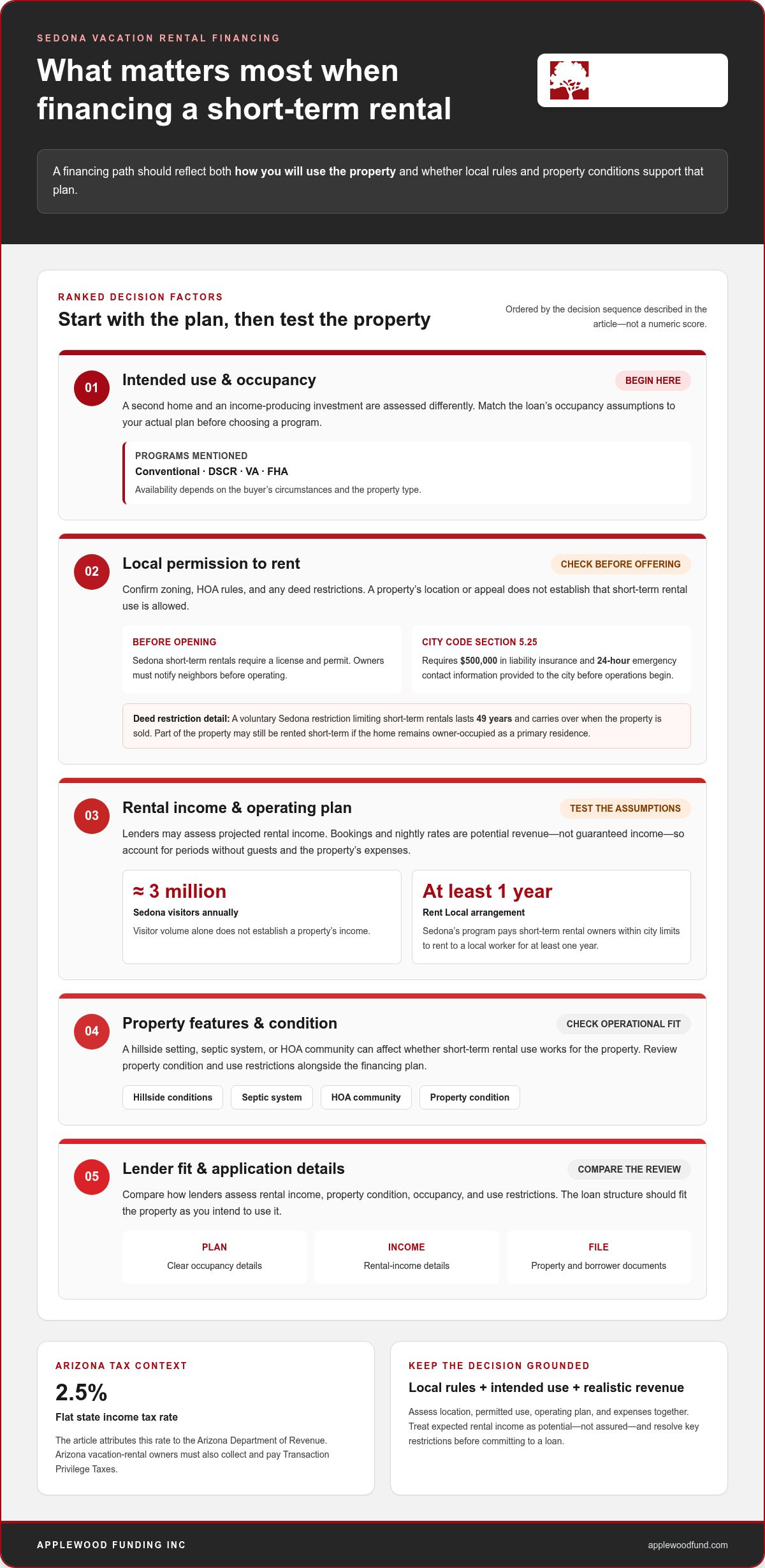
Financing a Sedona vacation rental is possible, but the right loan depends on the property and how you plan to use it. Sedona vacation rental loans may include conventional or DSCR financing, while VA or FHA loans may suit some buyers and property types. Local zoning rules and homeowners association restrictions can also affect whether a property can be used as a short-term rental.
That’s why a vacation-home plan and an investment-property plan can lead to different financing paths. You’ll learn how occupancy, down payment, rental income, and application documents shape qualification for Sedona and other Arizona properties. We’ll also cover local use restrictions and explain how to assess your next financing step with a clearer picture of the deal.
Key Takeaways
- Match the financing path to the property’s intended use: a second home and a rental investment are assessed differently.
- Before buying, consider Sedona zoning and HOA rules that can affect short-term rental use.
- Arizona’s state income tax rate is a flat 2.5%, according to the Arizona Department of Revenue.
- For Arizona counties outside the Phoenix metro, the 2026 conforming loan limit is $832,750, according to the Federal Housing Finance Agency.
- Prepare a clear occupancy plan, rental-income details, and property and borrower documents to support your financing application.
Can I finance a Sedona vacation rental or short-term rental investment property?
Yes. Sedona buyers may use conventional, DSCR, VA, or FHA financing, depending on their circumstances and property type. First, match the loan’s occupancy assumptions to your actual plan, then assess local restrictions on rental use.
Short-Term Rental Financing
Financing a Sedona short-term rental means evaluating the property as an income-producing investment or vacation home, not simply choosing a loan by name. Sedona vacation rental loans can differ based on intended occupancy, projected rental income, property features, and the loan program. A hillside home, septic system, or HOA community can also affect whether short-term rental use works for the property.
Before making an offer, identify the property’s zoning and HOA rules and determine whether short-term rentals are allowed. Sedona vacation rentals require a license and permit before opening for business, and owners must notify neighbors before operating. Under City Code Section 5.25, owners must maintain $500,000 in liability insurance and provide the city with 24-hour emergency contact information before operations begin.
Also consider whether a deed restriction changes the investment plan. A voluntary Sedona deed restriction limiting short-term rentals lasts 49 years and carries over when the property is sold. A homeowner who places that restriction may still rent part of the property short-term if the home remains owner-occupied as a primary residence. That distinction matters if you plan to live onsite.
Sedona’s Rent Local program pays short-term rental owners within city limits to rent to a local worker for at least one year. This can shift the strategy from nightly guest stays to a longer local-worker arrangement. Arizona’s state income tax rate is a flat 2.5%, according to the Arizona Department of Revenue.
Lender Selection and Borrower Risks
What are the best lenders for vacation rental loans in Sedona, Arizona? Look for a lender whose program matches your occupancy plan and evaluates the property as you intend to use it. Compare how the lender assesses rental income, property condition, and use restrictions before selecting a loan structure.
What risks should borrowers consider before financing a Sedona vacation rental? Zoning limits, HOA restrictions, deed terms, hillside conditions, and septic systems can affect rental use or operations. Income also depends on bookings and nightly rates. Treat those figures as potential revenue, not guaranteed income, and budget for periods without guests.
Sedona attracts approximately 3 million visitors annually, but visitor volume alone doesn’t establish a property’s income. Assess its location, permitted use, operating plan, and expenses together. Resolve those questions before committing to a loan, especially when the purchase depends on short-term rental income.
Vacation property financing across Arizona lifestyle markets
Arizona vacation properties range from Sedona short-term rentals to Flagstaff retreats and Prescott homes. The setting shapes the financing discussion: a property bought for occasional personal use has a different plan from one operated for rental income. Before comparing loan options, define the intended use, identify needed improvements, and estimate how rental activity fits your budget. These steps help you discuss a financing structure suited to the property, not just its destination appeal.
Loan size is another early checkpoint. For 2026, the conforming loan limit for Arizona counties outside the Phoenix metro is $832,750, according to the Federal Housing Finance Agency. Compare the planned loan amount with the applicable county limit. A conforming limit is not a promise of approval; the borrower, property, occupancy, and loan terms still matter. If the amount exceeds the limit, financing may require a different structure, so include that possibility in the purchase plan.
Vacation rental operations also bring tax responsibilities. Arizona vacation rental property owners must collect and pay Transaction Privilege Taxes. Include tax administration in the operating plan alongside booking income, upkeep, and other property expenses. Before launching a rental, organize reservation and receipt records, and understand how the property’s rental activity will be reported. A clear process helps you track income without treating gross booking revenue as spendable cash.
Construction financing calls for a project-focused review. For a new build or major improvement, organize the land details, construction plans, project budget, and intended property use. Construction financing focuses on how the project will progress from site preparation to a completed property, while land financing focuses on the parcel and its development plan. Keep those needs distinct: a finished vacation property and undeveloped land are different financing situations, even when they support the same Arizona lifestyle goal.
Arizona homeowners facing foreclosure should act early and keep their paperwork together. Contact the mortgage servicer, explain your current circumstances, and ask what loss-mitigation options apply. Gather the loan statement, income and expense records, and any notices received. Keep copies of communications and note follow-up dates. These steps help you understand the account status and make informed decisions before pursuing another property purchase or borrowing against an existing one.
Build a practical comparison before choosing a financing route: property use, loan size, construction needs, tax administration, and household obligations. For example, a Flagstaff retreat at 7,000 feet may involve a different property plan from a Prescott home or a Sedona rental. Arizona’s lifestyle markets aren’t interchangeable. Match the financing discussion to the location, intended use, and project stage, then assess whether the expected income and carrying costs support the purchase plan.
Vacation-home occupancy and down-payment considerations
Occupancy is a key starting point for financing a Sedona vacation home. A second home is generally intended for the borrower’s personal use, while an investment property is acquired primarily to earn rental income. How you plan to occupy the home can affect the loan program, down payment, and payment assessment. Describe your actual plan accurately, including whether guests will rent the entire property or only part of it.
How do second-home loans compare with investment-property loans for a Sedona vacation rental? Second-home financing centers on personal use, while investment-property financing considers the home’s rental purpose and income potential. The occupancy category should reflect the property’s actual use, not simply the loan terms you prefer.
Down-payment requirements depend on the loan program, occupancy classification, borrower finances, and property details. Compare the required contribution with the cash you’ll need after closing for repairs, furnishings, and periods without bookings. For example, a buyer planning occasional family stays should budget differently from an owner relying on guest income to cover the payment. Keep reserves available instead of committing every available dollar to the purchase.
Location shapes both the ownership experience and the financing review. Compare access to Sedona’s downtown, trail areas, and resort locations with your intended use. A home close to attractions may suit frequent guest stays, while a quieter location may better match personal retreats. Review the property’s condition and practical access, too. A hillside home or a property with a septic system may require additional assessment before you settle on a purchase plan.
Owning a vacation home can give you a familiar place for personal stays and a property that may generate rental income when you’re away. Those benefits depend on a workable occupancy plan, permitted rental use, and a realistic budget. Treat the home as both real estate and an ongoing responsibility: plan for maintenance, guest turnover, taxes, and periods when rental income doesn’t cover expenses.
For Sedona home builders, private construction financing may be relevant when the goal is building rather than buying a completed vacation home. Organize the land information, building plans, project budget, and timeline before discussing financing. Separate construction costs from future operating costs. This gives the financing review a clearer picture of the project and the completed property’s intended use.
Get pre-approved before making offers. Prepare income and asset records, existing debt details, and a clear occupancy statement. Then discuss the purchase price, expected down payment, and any planned rental use. A pre-approval helps establish a workable purchase range, but the lender still evaluates the specific property and loan application. Update your documents if your finances or intended use change before closing.
DSCR loans for income-producing properties
A debt service coverage ratio loan, or DSCR loan, focuses on whether a property’s income can support its debt payments. For a Sedona real estate purchase, the lender evaluates the rental property and its cash flow alongside the loan terms. This approach may suit investors whose financing centers on an income-producing property rather than personal occupancy. Start by separating projected rent from the costs of operating the property.
The DSCR calculation compares qualifying property income with debt service. Debt service generally refers to required loan payments, while the lender’s calculation may also account for property expenses. A ratio above the lender’s required threshold indicates that income exceeds the payments included in the calculation. Programs define qualifying income and expenses differently, so understand how each item is treated before relying on a projection.
Build a property-level income estimate before choosing a loan structure. Use the planned rental model, expected booking activity, and documented property information. Then subtract operating costs such as maintenance, utilities, insurance, taxes, and management expenses. For example, a home with strong booking revenue can still produce limited cash flow if upkeep and operating costs absorb much of its income. Compare the net estimate with the anticipated loan payment.
Potential rental income is not the same as money available for debt payments. Guest cancellations, vacant dates, repairs, and changes in operating costs can affect the cash left after expenses. Make a conservative budget that includes time without bookings and routine maintenance. For a Sedona home marketed to visitors, assess the property’s location, condition, and intended rental schedule together. Don’t base the financing decision on the most optimistic booking scenario.
Keep the rental plan consistent across the loan application and property records. Prepare a clear use statement, rental history if available, income projections, operating-cost estimates, and details about any management arrangement. If the property is newly purchased, distinguish estimates from documented rental results. This gives the lender a clearer view of the assumptions behind the proposed income and helps you identify whether financing depends on future bookings.
Income-based home repair assistance is a separate path from DSCR financing. Sedona Home Repair Program applicants’ household income cannot exceed 80% of area median income. To qualify, a homeowner must occupy the property and be current on homeowner’s insurance, mortgage payments, and property taxes. The program’s owner-occupancy criteria make it distinct from a loan underwriting an investment property’s rental cash flow.
Use a simple sequence: confirm the property’s permitted use, build a defensible operating budget, calculate expected cash flow, and compare it with loan payments. Then discuss your assumptions with the lender before purchase. This helps you judge whether a Sedona rental’s income plan supports the financing, rather than relying on destination appeal alone.
Loan application and documentation
Lenders qualify Sedona short-term rental borrowers by reviewing the borrower, property, intended occupancy, and repayment plan. Prepare records showing how you’ll fund the purchase and operate the rental.
Application Documentation
Start with a complete application and a consistent description of the property’s use. Assemble identification, income and asset records, debt details, purchase information, and any available rental history. For a newly acquired home, separate projected bookings from actual rental results. Include the property address and relevant condition details, such as a mountain location or planned repairs.
Property documents help the lender assess the collateral and proposed use. Gather the purchase contract, property listing, insurance information, and any available inspection or appraisal materials. If the home is in an HOA community, include governing documents relevant to rental use. For a construction project, organize the plans, budget, and completion details so the lender can evaluate the proposed work.
Loan Amounts and Borrower Qualification
How do lenders qualify borrowers for a short-term rental property loan in Sedona? They assess the borrower’s finances, the property’s value and condition, intended occupancy, and repayment plan. For an income-based loan, rental projections and operating costs may also inform the review.
Loan amount ranges vary by program and transaction. The requested amount generally relates to the purchase price or appraised value, the borrower’s available funds, and the lender’s terms. For construction, loan-to-completed-value limits compare the proposed financing with the projected value after work is finished. The lender evaluates the appraisal, construction budget, and plans to determine how much of that completed value supports the loan.
VA and FHA loans may be options for some buyers, depending on their circumstances and property type. These programs may not fit every short-term rental plan. Explain whether the home will be a personal vacation property, a primary residence, or an income-producing investment. That distinction helps direct the application toward an appropriate financing structure.
Review the application for consistency before submission. If the purchase contract identifies one use but the application describes another, the lender may need clarification. Match the occupancy plan, income estimates, and property documents. For example, an owner planning occasional stays and guest bookings should describe both uses clearly. Keep updated records ready if the purchase terms or project scope change during underwriting.
For a focused review of your borrower and property details, discuss your Sedona mortgage financing.
Applewood Funding: Owner Occupied Hard Money Loans
Applewood Funding offers Owner Occupied Hard Money Loans for borrowers financing a property they’ll occupy as their primary residence. If your Sedona home will instead operate as an income-producing rental, Rental Property Loans may better match that investment plan. The key distinction is intended occupancy, so align the financing discussion with how you’ll actually use the property.
For a home purchase involving major improvements, Fix and Flip Loans may fit a renovation-focused project. For a ground-up build or land purchase, Construction and Land Loans address a different stage of the real estate plan. Set out the property’s intended use and project needs before discussing financing.
Contact Applewood Funding to discuss your financing plans, or visit Applewood Funding online.
Set Your Financing Plan in Motion
Your next step is to turn the property idea into a clear financing brief. Write down how you’ll use the home, what you can contribute, and whether the plan depends on rental income. Add the property details and any known restrictions. This gives your financing conversation a practical starting point and brings key assumptions into focus.
For sedona vacation rental loans, keep the planned occupancy and rental strategy aligned from the first discussion through the application. If your intended use changes, update the plan before moving forward. Clear information helps frame the right questions about financing structure and property fit.
Applewood Funding offers Owner Occupied Hard Money Loans, Fix and Flip Loans, and Rental Property Loans. Discuss your property and financing goals with the team to consider a path that fits your plans. Contact Applewood Funding to discuss financing, and take the next step with a clearer plan.
Frequently Asked Questions
What loan types are available for buying a vacation rental in Sedona, Arizona?
Common options include conventional and DSCR loans, with VA or FHA financing available for some buyers and property types. The right category depends on actual use: a personal vacation home differs from a rental investment. Applewood Funding offers Rental Property Loans for investment properties and Owner Occupied Hard Money Loans for homes borrowers will occupy. Owner Occupied Home OK. Keep the financing plan aligned with the property’s intended use.
What are current mortgage rates and down payment requirements for Sedona vacation rental loans?
Rates and down payments depend on loan structure, occupancy, borrower finances, property value, and underwriting. Arizona markets including Phoenix, Scottsdale, Glendale, Peoria, Tempe, Mesa, Sedona, Flagstaff, and Tucson can involve different property profiles, so compare terms for the specific purchase. Applewood Funding states, “You Will Get the Lowest Rates GUARANTEED.” Review the full proposed terms and resulting payment, not the rate alone.
Can projected Airbnb or VRBO income be used to qualify for a Sedona vacation rental mortgage?
Yes, projected Airbnb or VRBO income can factor into DSCR qualification. Underwriting evaluates whether expected rental cash flow supports the property’s debt service. Present your assumptions clearly, including nightly pricing, expected bookings, seasonal vacancies, management costs, maintenance, insurance, and taxes. Separate documented booking history from estimates, especially for a new Sedona listing without operating records. A realistic net-income picture is more useful than gross booking revenue alone.
How do Sedona short-term rental regulations affect loan approval and property eligibility?
Local use rules can affect whether a property supports the rental plan behind an investment loan. In Sedona, zoning, HOA covenants, and deed restrictions can limit short-term rental operations; a license and permit are required before opening. If property documents restrict the planned use, projected rental income may not support the application as intended. Review permitted use and recorded documents before relying on nightly rental income in your financing plan.
What steps and documents are needed to apply for a vacation rental loan in Sedona?
State intended occupancy and purchase purpose; submit the contract, income and asset records, debts, and available rental documents. Add insurance and repair plans when relevant. Applewood Funding Inc Licensed AZ Mortgage Broker and Licensed Loan Originator NMLS-175371 AZ MB-0903207 offers “No Up-Front Fees – No Cost to Apply,” no junk fees, and no credit required. Owner Occupied Home OK; flexible terms from 3 to 360 months. Just Text or Call 602-497-4444 to Get Started.