


Hard money for fix and flip: costs and down payment needs
October 22, 2026Alternative lending for homeowners: Qualification and refinancing options

Alternative lending for homeowners can create a path to mortgage qualification when income, assets, or credit don’t fit a standard application. In the United States, lenders generally document and verify income, employment, assets, debts, and credit history to assess the ability to repay. Some loans outside qualified-mortgage criteria may carry greater risk or expense, so compare the terms with the benefit of qualifying.
Refinancing may also be possible when your income comes from self-employment or your financial picture includes retirement assets. A cash-out refinance still requires qualifying income, while 401(k) and IRA assets may be considered as part of a refinance application. The right route depends on what you need from the loan and what your finances can support.
This guide explains what lenders may weigh, how alternative mortgage options differ, and what to consider before refinancing or taking cash out. You’ll also see how to assess loan terms and identify a practical next step, without assuming that one financing route fits every homeowner.
Key Takeaways
- Understand which financial details lenders use to assess your ability to repay, and how that review can shape your qualification options.
- Learn when a non-traditional lender may be relevant, especially if your income or financial profile doesn’t fit a conventional application.
- Explore alternative ways to document income and organize your records to make your financial picture clearer.
- Compare the purpose and trade-offs of cash-out refinancing before using home equity to access funds.
- Review loan terms for key risks and transparency, including payment changes, fees, and features that can affect repayment.
Mortgage qualification and ability-to-repay requirements
Mortgage providers assess how a borrower can repay, considering the overall financial picture rather than just one factor. For self-employed homeowners, bank statements can help demonstrate income. Applewood Funding Inc offers bank statement loans for self-employed borrowers, as well as owner-occupied home loans for people seeking an alternative to conventional qualification.
Qualification applies to home purchases and refinancing. For a purchase, lenders assess your finances alongside the property and requested loan. For a refinance, they review your ability to handle the new payment and may consider retirement assets, including 401(k)s and IRAs. A cash-out refinance also requires qualifying income. Home equity can be part of the picture, but it does not replace the income requirement.
Loan type matters. FHA mortgages are available to borrowers with lower credit scores and low down payments. VA mortgages serve veterans, servicemembers, and surviving spouses. USDA mortgages are intended for low- to middle-income borrowers in rural areas. Most U.S. mortgage loans are conventional. These options have different qualification paths, so identify which category fits your purpose and circumstances before comparing terms.
Rate structure shapes payments over time. A fixed-rate mortgage keeps its interest rate and monthly principal-and-interest payment unchanged. Taxes, homeowner’s insurance, or mortgage insurance can still change the total monthly payment. Most adjustable-rate mortgages have two periods: an initial fixed-rate period, followed by regular rate changes tied to market conditions. Some ARMs have caps that limit adjustments, but after the introductory period, monthly principal and interest could increase substantially, even double.
Nonqualified mortgages, or non-QM loans, have characteristics that don’t meet qualified-mortgage criteria and may carry different risks and costs. Compare the interest rate, APR, payment schedule, and listed fees side by side. There is no single rate or fee for every alternative home loan. Pricing depends on the loan structure, borrower’s finances, property, and repayment risk. Focus on the full terms, not one advertised figure.
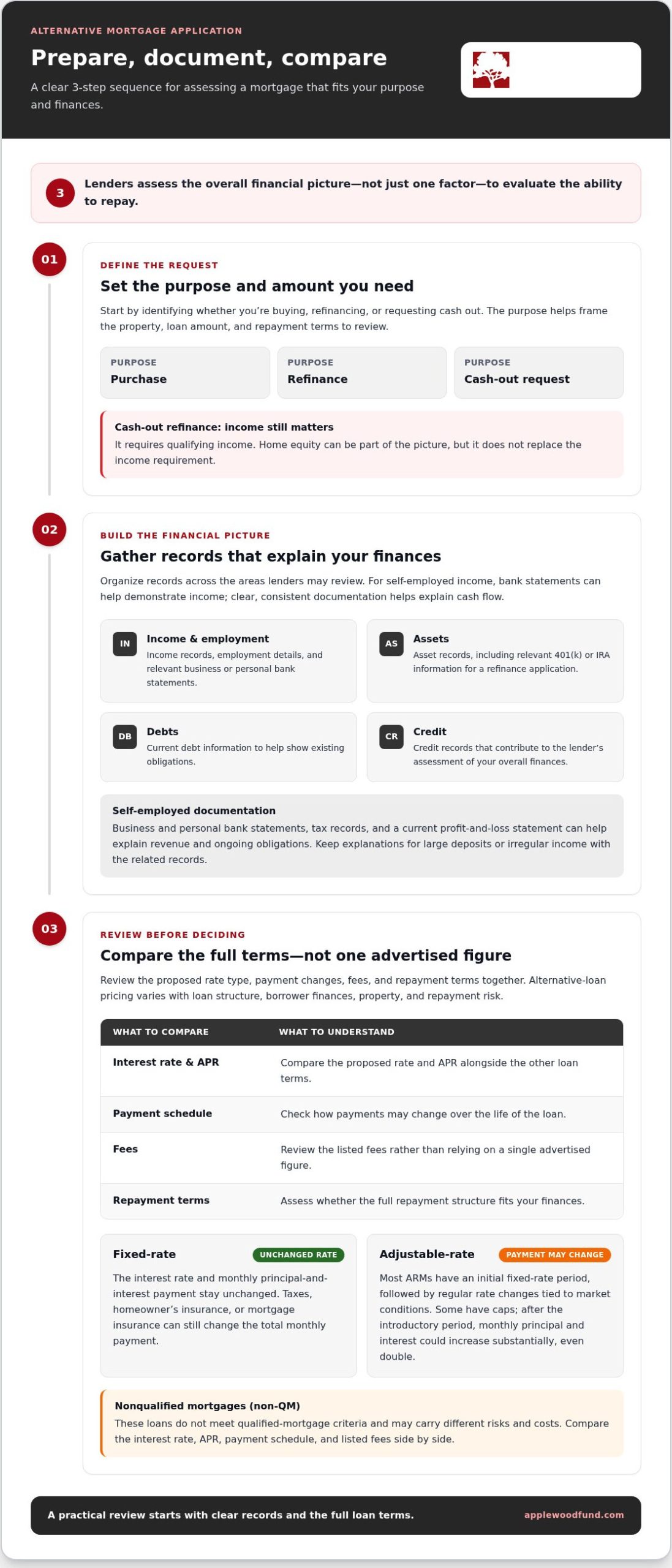
Make your application easier to assess with a clear sequence. For alternative lending for homeowners, prepare the records that explain income, assets, debts, and credit, then define whether you’re buying or refinancing.
- Set the purpose and amount you need, such as a purchase, refinance, or cash-out request.
- Gather income, employment, asset, debt, and credit records, including relevant retirement-account information.
- Review the proposed rate type, payment changes, fees, and repayment terms before deciding whether the mortgage fits your finances.
What Is a Non-Traditional Mortgage Lender?
Alternative mortgage options can suit borrowers with self-employment income or complex finances. Home equity products offer other ways to access funds: a home equity loan pays a lump sum, a HELOC provides a revolving line of credit, and cash-out refinancing replaces the existing mortgage with a larger one. Applewood Funding also offers Cash-Out Hard Money Loans for homeowners seeking to leverage property equity.
Borrowers Served by Non-Traditional Lenders
These lenders may suit borrowers whose income varies, comes from self-employment, or doesn’t fit a standard pay-stub pattern. They may also consider the property’s equity and the loan’s purpose alongside the borrower’s overall financial picture. Look closely at what the lender uses to assess repayment, including income records, debts, credit, and available home equity.
A HELOC has its own qualification factors. Homeowners typically need 15% to 20% equity, and a credit score of at least 680 is commonly required. Equity alone doesn’t establish eligibility; income, existing mortgage debt, and the proposed line of credit also matter. Compare the amount available with the repayment obligations before treating home equity as spendable cash.
Self-Employed Income Documentation
Self-employed borrowers can make income easier to assess by organizing records that show revenue and ongoing obligations. Prepare business and personal bank statements, tax records, and a current profit-and-loss statement. Keep explanations for large deposits or irregular income alongside the relevant records. Clear documentation helps explain how business cash flow supports household mortgage payments.
Ask how income that changes month to month is evaluated. A bank statement approach, for example, focuses on deposits rather than a conventional paycheck. Consistency matters: statements, tax documents, and business records should present a coherent picture of income. Applewood Funding offers bank statement loans for self-employed borrowers in Arizona.
How do home equity loans, HELOCs, and cash-out refinancing compare? A home equity loan provides a lump sum repaid in fixed monthly payments. A HELOC is a revolving line with generally variable interest, while cash-out refinancing replaces the current mortgage and releases some equity as cash.
During a HELOC draw period, borrowers may be able to pay interest only, with principal payments starting after that period ends. Cash-out refinancing typically requires a credit score of at least 620 and retaining at least 20% equity after withdrawal. Compare how each option changes your mortgage balance, payment structure, and access to funds.
Before applying, define the purpose of the borrowing, calculate the equity you want to use, and assemble income and debt records. Then compare the repayment structure and loan terms against your household budget. To explore mortgage financing options, start with the loan purpose and the records that explain your financial picture.
Alternative income documentation methods
A mortgage application should show how income reaches you and how reliably it can support payments. For a salaried borrower, pay statements may tell that story. A self-employed borrower, contractor, or business owner may need records that capture uneven deposits and business expenses. Organize documents by income source and make sure they support a consistent financial picture.
Bank statements can show deposits over time, which may help explain income that doesn’t arrive on a fixed schedule. Separate business and personal accounts where possible, and label transfers so they aren’t mistaken for earnings. A deposit total is not automatically income available for a mortgage: business costs, refunds, and transfers can affect what the statements mean. Keep related records together.
Tax returns provide another view. They may show income after deductions, while bank statements show cash flowing into an account. If those figures differ, prepare a clear explanation supported by invoices, contracts, or accounting records. Don’t present gross receipts as take-home income. A lender needs to understand what remains available for mortgage payments, other debts, and ordinary living expenses.
Some borrowers also receive income from investments, retirement accounts, or other assets. For a refinance, 401(k) and IRA assets may be considered in mortgage qualification. An asset is not the same as recurring income, so distinguish account balances from regular distributions. Note whether funds are accessible and whether withdrawals affect your long-term financial plan. Your equity and credit history add context, but don’t replace income evidence.
Build a file that makes your financial picture easy to follow. Include the records relevant to each income stream, then reconcile differences before submitting an application:
- Match bank deposits with invoices, contracts, or accounting entries.
- Identify transfers between accounts so they aren’t counted twice.
- Explain seasonal or irregular earnings with records showing the source.
- Separate business expenses from personal spending where records allow.
- List retirement assets separately from recurring income and distributions.
Ask which documentation method applies to the mortgage product and how the lender calculates usable income. A bank statement loan for a self-employed borrower may assess deposits differently from a program relying on tax returns. That distinction can affect the qualifying income, loan structure, and interest rate. Compare the full mortgage terms, including payment requirements, rather than focusing on interest rates alone.
Prepare a concise summary that connects the records: income source, deposit pattern, business costs, existing obligations, and intended use of the mortgage loan. If you’re a credit union member or use several financial institutions, include the accounts relevant to your application. Clear organization gives the lender a practical way to evaluate your finances without confusing equity, savings, and earned income.
Cash-out refinancing
A cash-out refinance replaces your current mortgage with a new mortgage for a larger amount. The new loan pays off the existing principal, and the remaining proceeds go to you as cash. Homeowners may use the funds for a major expense or another financial goal. But the choice changes the debt secured by the home, so weigh the cash received against the new balance and monthly payment.
Start with the home’s value and current mortgage balance. For example, a U.S. home valued at $500,000 with a $350,000 mortgage balance has $150,000 in equity, or 30% of its value. That equity is not automatically available as cash. A cash-out refinance typically requires at least 20% equity to remain after withdrawal, and the permitted amount depends on the property and loan qualification.
Qualification still matters. A cash-out refinance requires qualifying income, and it typically requires a credit score of at least 620. A lender also weighs existing debts and the proposed payment. Equity can help establish the loan amount, but it does not replace the ability-to-repay review. Compare the new mortgage terms with your current loan before treating the proceeds as flexible money.
Look beyond the cash amount. Check the interest rate, repayment period, principal balance, and whether the new monthly payment fits your budget. If the refinance changes a fixed-rate loan to an adjustable-rate mortgage, understand when the rate can change and how that affects payments. A lower initial payment doesn’t tell the full story if the rate can rise later.
Use a simple comparison before applying:
- Estimate the home’s value and subtract the current mortgage balance to understand available equity.
- Decide how much cash you need, rather than borrowing the maximum available.
- Compare the new principal and monthly payment with your existing mortgage.
- Review the rate structure and repayment terms, including any adjustable-rate changes.
- Confirm that your income records support the new payment and the requested loan amount.
A cash-out refinance may fit when you want to replace your mortgage and access equity through one loan. A home equity loan or HELOC keeps the existing mortgage in place and adds separate borrowing, so compare the combined payments and debt structure. The right choice depends on your current loan, equity, income, and use for the funds. Applewood Funding offers Cash-Out Hard Money Loans in Arizona.
Before proceeding, write down the amount you need and the purpose for borrowing. Then compare complete mortgage offers using the same loan amount and repayment assumptions. This makes differences in interest rates, principal, and monthly payments easier to spot, helping you judge whether the added debt supports your financial situation.
Evaluating lender safety and transparency
Start with the written terms, not a verbal summary. Compare the amount borrowed, interest structure, monthly payment, repayment period, and closing costs. Ask how each charge is calculated and when it is due. Review the full obligation from application through closing, including any balloon payment, interest-only feature, prepayment penalty, or negative amortization. Applewood Funding’s owner-occupied loans have no up-front fees, no junk fees, and no cost to apply.
What federal and state rules protect homeowners using alternative mortgage lenders? In the United States, lenders generally must document and verify income, employment, assets, debts, and credit history to assess ability to repay. Applicable protections and requirements depend on the loan and state, so read the Loan Estimate and final documents for the specific terms and costs.
Use the Loan Estimate to compare mortgage offers, especially if one includes a feature that changes payment timing or balance. Match the loan amount and repayment assumptions across offers. Then compare the interest rate, estimated closing costs, and projected monthly payment. A rate alone can hide important differences in fees or loan structure.
What are the risks of alternative lending secured by a home? A mortgage secured by your home puts that property at risk if you cannot meet the repayment terms. Nonqualified mortgages that fall outside qualified-mortgage criteria may be riskier or more expensive, and alternative mortgage lenders played a major part in the 2008 foreclosure crisis.
Look for terms that can make the balance or payment harder to manage. A balloon payment creates a large amount due at a stated point; negative amortization can increase principal instead of reducing it. An interest-only period delays principal repayment, while an adjustable rate can change later. Understand the trigger, timing, and payment effect of each feature before signing.
Review the documents in a deliberate order:
- Match the loan amount, interest rate, monthly payment, and repayment period across the offer and closing documents.
- Identify every fee, the party receiving it, and when payment is due.
- Find any balloon, prepayment penalty, interest-only, or negative-amortization term.
- Confirm how a rate adjustment affects payments and when that adjustment begins.
- Compare the new payment with household income and existing debt obligations.
Home equity can make borrowing possible, but using it increases the debt secured by your home. Keep a copy of each disclosure and note differences between the initial estimate and closing paperwork. If the numbers or terms changed, get the change explained in writing before signing. A careful review helps you make an informed decision.
For a mortgage secured by an owner-occupied property, discuss owner-occupied financing options in light of your repayment plan and the terms you need to understand.
Applewood Funding: Owner Occupied Hard Money Loans
Applewood Funding offers Owner Occupied Hard Money Loans for homeowners seeking financing secured by a property they live in. This option may fit borrowers whose income or financial profile calls for an alternative to conventional mortgage qualification. Review the repayment terms, rate structure, fees, and monthly payment carefully before deciding whether the loan works for your situation.
For an investment or development property, Applewood Funding also offers Fix & Flip Loans, Rental Property Loans, and Construction and Land Loans. Choose the financing that matches the property’s use and your borrowing goal.
Contact Applewood Funding to discuss your owner-occupied financing needs, or visit applewoodfund.com.
Choose a Financing Path That Fits Your Next Move
Your next step is to connect the loan decision to a clear financial goal. Before moving forward, write down what the financing needs to accomplish, what payment you can manage, and how the loan fits your plans for the property. That gives you a practical way to weigh flexibility against the long-term cost of borrowing.
Alternative lending for homeowners can be one route when your priorities or financial profile call for a different financing approach. Keep the decision grounded in the written terms and your own repayment plan. If the structure doesn’t support your goal, pause and reassess before committing.
Applewood Funding offers financing options for owner-occupied homes, property investments, and rentals. To discuss whether an owner-occupied option aligns with your plans, contact Applewood Funding. Take the next step with a clear goal and a plan you understand.
Frequently Asked Questions
What alternative lending options are available to homeowners in the United States?
Options include nonqualified mortgages, home equity loans, HELOCs, cash-out refinancing, and reverse mortgages. FHA, VA, and USDA loans may also fit eligible borrowers’ circumstances. Match the option to your goal: a HELOC provides a revolving credit line, while a cash-out refinance replaces your existing mortgage. Reverse mortgages are available to homeowners aged 62 or older. The best starting point is identifying whether you need purchase financing, refinance funds, or access to equity.
Can homeowners with bad credit or irregular income qualify for alternative lending?
Some homeowners with poor credit or uneven income can qualify, depending on the lender’s criteria and the full financial picture. Self-employed borrowers can organize bank statements, tax records, invoices, and business records to show income patterns and expenses. If deposits vary by season, explain the pattern with supporting records. Compare how each lender assesses income, debt, property equity, and repayment ability before selecting a loan structure.
How much can homeowners borrow against their home, and how is loan-to-value calculated?
The available amount depends on the home’s value, current mortgage balance, and the loan’s equity requirements. Loan-to-value compares the requested loan balance with the property’s value: divide the loan amount by the value and express the result as a percentage. For example, a $350,000 mortgage on a $500,000 home equals 70% LTV. For cash-out refinancing, homeowners typically retain at least 20% equity after withdrawing funds.
How can homeowners compare lenders and verify that an alternative lender is legitimate?
Compare written offers using the same loan amount and repayment assumptions. Review the interest rate, monthly payment, closing costs, and terms that could change payments or principal. In Arizona, confirm a lender’s identity and credentials, then match the offer to its disclosures. Applewood Funding Inc identifies itself as a private hard-money lender and lists AZ MB-0903207 and NMLS-175371. Its stated terms include no up-front fees, no cost to apply, and terms from 3 to 360 months.
What interest rates and fees do alternative home loans typically charge?
There is no single typical rate or fee; pricing depends on the loan structure, your finances, the property, and repayment risk. Compare the interest rate, APR, payment schedule, and all listed fees, since nonqualified mortgages may be riskier or more expensive.