


How to Get Preapproved for a Hard Money Loan in Scottsdale
October 17, 2026Private Lender vs. Big Bank: Which Home Financing Path Fits in Arizona?

The strongest borrower on paper may not have the strongest financing fit. In the private lender vs big bank decision, the key difference often comes down to what gets the most weight: your income and credit profile, or the property and its available equity. That distinction can shape the financing path for Arizona buyers, especially when a property or timeline doesn’t fit a conventional loan process.
It’s reasonable to favor a bank’s familiar structure and wonder whether private financing’s flexibility comes with trade-offs. Neither option is automatically better. The right fit depends on your property, how you’ll repay the loan, and how much time you have.
This comparison explains how private lenders and banks may assess borrowers, collateral, and timing, along with the costs and compromises to consider. You’ll also find practical steps for preparing property details and income documents. For self-employed borrowers, bank statement loans offer another path to consider. Applewood Funding also provides owner-occupied hard money loans for borrowers financing a home they plan to live in. Start with your goals and the facts of your Arizona property, then compare the route that aligns with both.
Key Takeaways
- Compare the private lender vs big bank path against your property, occupancy plans, finances, and repayment strategy.
- Prepare to explain both your borrower profile and the property’s condition, equity, and intended use, since lenders may weigh these factors differently.
- Look beyond potential flexibility or timing. Compare the full borrowing trade-offs and terms before deciding.
- Organize your financial records and property details, then describe your specific situation in Phoenix, Mesa, Tempe, or another Arizona community.
- Applewood Funding offers owner-occupied hard money loans and bank statement loans for self-employed borrowers, two options designed for different financing circumstances.
Private Lender vs. Big Bank in Arizona: What Is the Real Difference?
Start with the property and your plan. Is it your primary residence, and what will you use the financing for? Then consider your financial circumstances and the time you have. The private lender vs big bank decision isn’t a simple choice between “easy” and “hard.” It’s a comparison of how different lenders review a loan request and whether their approach fits your situation.
A bank mortgage is a home loan offered by a bank, typically reviewed through that lender’s application and underwriting process. Private mortgage lending refers to loans funded by private lending sources rather than a traditional bank. It’s a financing category, not a promise of approval, favorable terms, or suitability. It’s also distinct from private banking, which generally refers to financial services for individual clients, not private mortgage lending.
In Phoenix, someone financing a move-in-ready home may have different questions from an owner considering a property that needs work. The same is true across Mesa, Tempe, Scottsdale, Glendale, Peoria, Sedona, Flagstaff, Tucson, and other Arizona communities. Lender criteria, property details, occupancy, and loan purpose can all shape the discussion.
What does a big bank evaluate in a mortgage application?
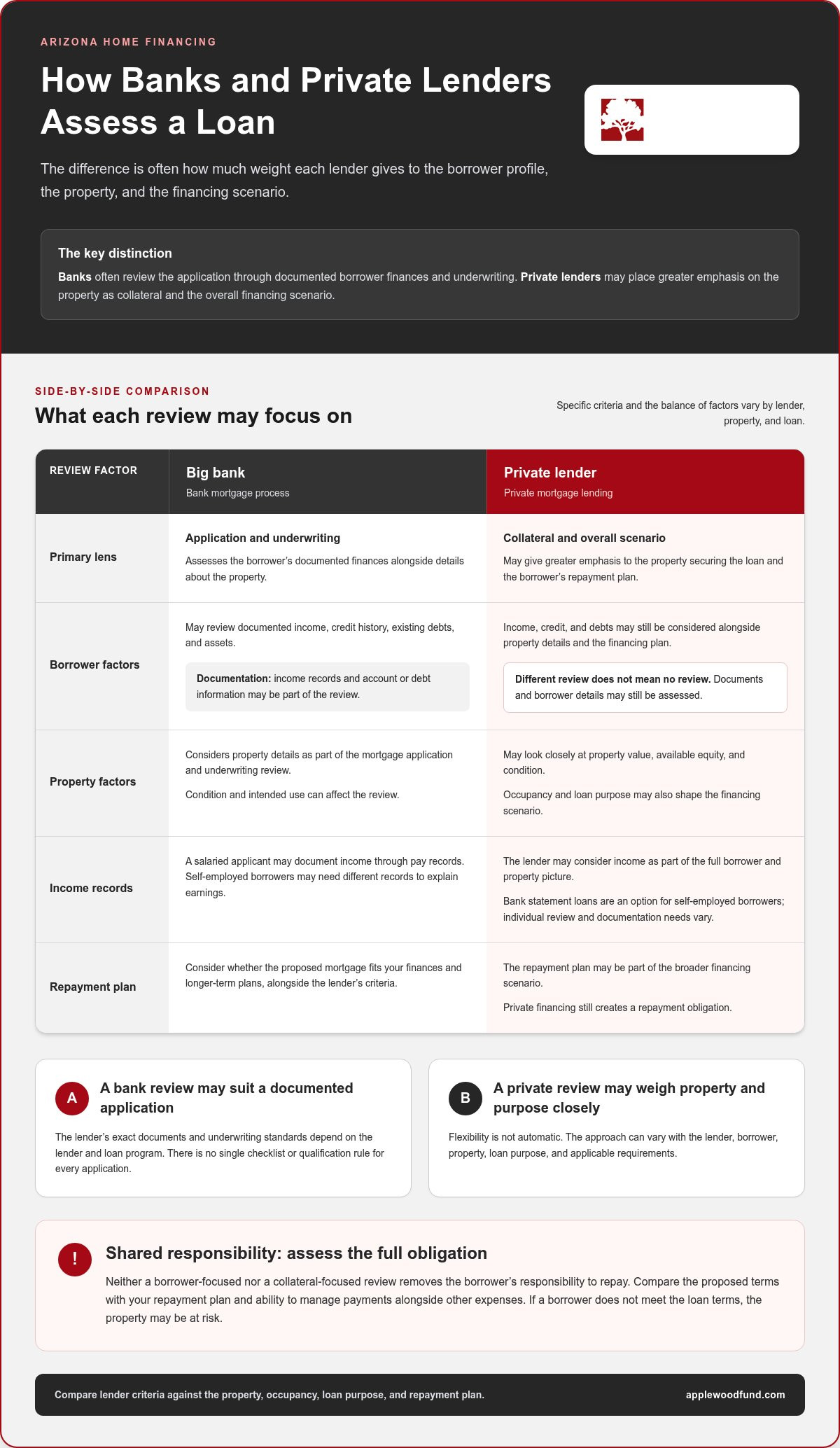
A bank may review documented income, credit history, existing debts, and details about the property. These factors help the lender assess the application and proposed mortgage. The exact documents and underwriting standards vary by lender and loan program, so there isn’t one universal checklist or qualification rule.
For example, a salaried applicant may document income through pay records, while a self-employed borrower may need different records to explain earnings. A property’s condition and intended use can also affect the review. Treat these as factors to prepare for, not automatic pass-or-fail rules.
Keep two questions separate: Does the application meet a lender’s criteria, and can you comfortably manage the repayment obligation? Underwriting is the lender’s review process. It doesn’t replace your own assessment of monthly payments, other expenses, and how the loan fits your longer-term plans.
How does private mortgage lending differ?
Private lenders may place greater emphasis on the property serving as collateral and on the overall financing scenario, including the borrower’s repayment plan. That doesn’t mean income, credit, or debts are irrelevant. A lender may consider these alongside property value, equity, condition, occupancy, and loan purpose. The specific balance varies by lender.
Flexibility isn’t automatic. It can vary based on the lender, borrower, property, loan purpose, and applicable requirements. Private financing still creates a repayment obligation, and the property may be at risk if the borrower doesn’t meet the loan terms. Review the full structure, not just whether a request can be considered.
For borrowers planning to live in the home, Applewood Funding offers owner-occupied hard money loans. Compare the proposed terms and repayment plan against your needs before moving forward.
How Banks and Private Lenders Assess Arizona Home Financing
A lender’s review connects two questions: who is borrowing, and what property secures the loan? Banks and private lenders may consider income documentation, credit, existing debts, available equity, property condition, and the repayment plan. The difference is often how much weight each factor receives. Neither a borrower-focused nor a collateral-focused review removes the borrower’s responsibility to repay.
That distinction matters for Arizona homeowners. A Phoenix buyer purchasing a finished primary residence presents a different financing scenario from someone seeking funds for a home that needs substantial work. A property in Scottsdale, Glendale, Peoria, or another Arizona community brings its own condition and transaction details. Location alone doesn’t determine the outcome; lender criteria and the specific property matter.
Why do banks often ask for extensive documentation?
Documents help a bank understand income, credit history, existing obligations, assets, and the property. Depending on the lender and loan, this may involve income records, account statements, debt information, and property documents. There’s no single checklist that applies to every application.
Consistent, documented income can help a lender assess a borrower’s ability to manage payments alongside other debts. Self-employed borrowers may need different records to explain how their income is earned and received. Bank statement loans are one financing option for self-employed borrowers, but documentation needs and outcomes depend on the individual loan review.
What may a private lender consider beyond a standard bank review?
A private lender may look closely at the property’s value, condition, and available equity, as well as the financing purpose and repayment plan. That broader view can make the overall scenario especially important. The American Association of Private Lenders (AAPL) provides information about the private real estate lending industry, but each lender sets its own approach.
A different review doesn’t mean no review. Private lenders may still require documents and assess the borrower, the property, and the plan. Compare the proposed obligation with your budget and repayment strategy. If you’re self-employed, learn how bank statement loans for self-employed borrowers can help document income.
Occupancy and purpose need a clear explanation. Financing a home you’ll live in differs from financing a rental property or a fix-and-flip project. Those purposes involve different plans for using the property and repaying the loan, so don’t assume a feature associated with one loan purpose applies to another. Be precise about whether the home will be owner-occupied, rented, or renovated for resale.
In the private lender vs big bank comparison, prepare both sides of the story: your financial picture and the property’s details. Describe the intended occupancy, current condition, available equity, and how you expect to repay. For a Phoenix-area discussion grounded in your actual situation, share your Arizona home financing scenario.
Private Lender vs. Big Bank: Compare the Trade-Offs Before Choosing
A useful private lender vs big bank comparison looks past the first “yes” or “no.” Weigh documentation, review approach, timing expectations, and the full repayment obligation together. A bank may suit a straightforward application, while private financing may merit consideration when a property or borrower’s circumstances call for a different review. Neither path guarantees approval, a particular schedule, or a better overall deal.
| Factor | Bank mortgage | Private mortgage lending |
|---|---|---|
| Documentation | May require detailed records of income, credit, debts, assets, and property information. Requirements vary by lender and loan. | Documentation still applies. The lender may consider borrower records alongside the property and financing scenario. |
| Underwriting focus | Often emphasizes the borrower’s documented finances and whether the application fits lender criteria. | May give more weight to collateral, available equity, property condition, purpose, and repayment plan. |
| Potential flexibility | Review follows the lender’s loan criteria; a property or income situation outside them may be harder to accommodate. | Some scenarios may receive a different review, but flexibility varies and isn’t automatic. |
| Timing | Application steps and review can take time, depending on the lender and the file. | A lender may move differently, but faster processing isn’t guaranteed. |
| Total borrowing trade-offs | Compare the complete terms, payment obligations, and any conditions of the loan. | Compare the full cost and repayment structure, not just access to funds. |
Use the table to frame questions about your actual loan scenario. Don’t treat “bank” or “private” as a complete description of terms. Review the written offer, understand what repayment requires over time, and consider how the loan fits your household or project budget. Access to funds is only one part of the decision.
When might a bank mortgage fit better?
A bank mortgage may be worth exploring if your finances are well documented and the property fits the lender’s criteria. For example, a borrower with consistent income records purchasing a home in standard condition may find that a bank’s review aligns with the transaction. Compare the full loan terms, payment schedule, and obligations. A familiar process doesn’t automatically make a loan the right fit.
When might private financing merit consideration?
Private financing may merit consideration if income records are nonstandard, the property has circumstances that complicate a conventional review, or a transaction has a tight timeline. These factors don’t promise approval or faster movement. Before proceeding, assess the complete borrowing cost, confirm that repayment is realistic, and define an exit plan, such as how you expect to pay off or replace the loan. A hard money loan’s potential benefits and risks both belong in that decision.
Protect the plan. Compare the repayment obligation and exit strategy before focusing on initial access to funds. If the plan depends on a future sale, refinance, or income change, consider what you’ll do if that step takes longer than expected or doesn’t happen. The strongest choice fits both the property and a realistic way to repay.
How Arizona Borrowers Can Prepare for a Lender Comparison
Bring a clear, consistent picture of the borrower, the property, and the plan. That makes the private lender vs big bank comparison more useful than a general conversation about lender types. Whether you’re in Phoenix, Mesa, Tempe, Tucson, or elsewhere in Arizona, explain your actual property situation, intended occupancy, and transaction timing. Details matter, and assumptions can distort a comparison.
Use this sequence to get organized:
- Define occupancy and purpose. State whether the home will be owner-occupied, used as a rental, or part of a renovation project. Be precise about what the financing is meant to accomplish.
- Organize your finances. Gather available income records, information about existing obligations, and relevant credit context. Self-employed borrowers may use bank statements as one possible way to document income, depending on the loan and lender. Explore bank statement loan options for self-employed borrowers.
- Document the property. Note its location, current condition, intended use, and any known details that may affect the financing discussion. Separate verified information from estimates, especially when describing property value or expected future proceeds.
- Compare written terms. Review the total obligations, repayment schedule, collateral implications, conditions, and your assumptions for paying off or replacing the loan.
What should you organize before comparing lenders?
Keep key details together: income records, existing debts, credit history context, property information, and transaction timing. Add supporting records that explain unusual details, such as variable income or planned repairs. Don’t present a projected sale price or future income as a certainty. Label estimates clearly so the discussion distinguishes documented facts from expectations.
For self-employed borrowers, bank statements may be one possible documentation route, but requirements aren’t universal. Prepare records that show how your income is received and be ready to explain the context. The goal isn’t to guess what a lender will require. It’s to provide an accurate starting picture of your finances.
How can you compare offers responsibly?
Read each offer in writing. Compare repayment responsibilities, payment timing, the property securing the loan, conditions, and what happens if your expected exit plan changes. Don’t focus only on initial access to funds. A projected refinance, sale, or income change is an assumption until it happens, so consider a backup plan if it takes longer than expected.
Owner-occupied mortgage requirements can differ from those for other loan purposes. Before making a decision, verify current requirements through authoritative federal and Arizona guidance, including the Consumer Financial Protection Bureau’s homeownership resources. Avoid relying on old summaries or assuming rules are identical across loan types.
Have a specific Arizona property or financing scenario to discuss? Share your home financing details with Applewood Funding to start a conversation grounded in your circumstances.
Explore an Arizona Private-Lending Conversation with Applewood Funding
After weighing a private lender vs big bank, make the comparison specific to your home and plans. Applewood Funding Inc provides alternative mortgage solutions in Arizona, including owner-occupied hard money loans. A useful financing conversation starts with the facts: what you want to accomplish, how you’ll use the property, your financial circumstances, and how you plan to repay.
Arrive with a clear outline of your situation and the information you have. That helps focus the discussion and distinguish possible financing paths. A home you intend to occupy presents a different purpose from a rental property or a project intended for renovation and resale.
What can borrowers discuss with Applewood Funding Inc?
Start with your goal. Are you purchasing a home, addressing a financing challenge, or considering another property-related need? Describe the property’s location and condition, whether you’ll live there, and what you know about its value and equity. Then explain your borrower circumstances, including income documentation, existing obligations, and the repayment plan you’re considering.
Self-employed borrowers can also discuss Applewood Funding Inc’s bank statement loans as a way to document income. This is a separate financing option to consider alongside the property and overall loan purpose, not an automatic fit for every situation. Applewood Funding Inc is managed by Joel McDaniel, NMLS 175371.
What is a sensible next step?
Bring organized, accurate details. Separate confirmed facts from estimates, especially around property value, future proceeds, or income you expect later. Be ready to explain how you would manage repayment and what your plan depends on. If the plan relies on a sale, refinance, or another future event, consider how you’d respond if it takes longer than expected.
As you discuss a potential loan, ask for a clear explanation of the applicable terms, payment responsibilities, conditions, and how the property secures the obligation. Take time to understand the complete repayment picture. A private-lending conversation is a chance to examine a scenario, not a promise that every request will qualify or that one financing route will suit your needs.
If you’re in Phoenix, Scottsdale, Glendale, Peoria, Mesa, Tempe, Sedona, Flagstaff, Tucson, or another Arizona community, start a conversation with Applewood Funding Inc about your Arizona home financing scenario.
Make Your Next Financing Decision With Clarity
The next move isn’t choosing a lender based on a label. Turn your financing needs into a clear plan: what the property requires, what repayment can realistically look like, and which terms you need explained before moving forward. That gives your private lender vs big bank decision a practical foundation, not just a preference for one process over another.
Before you act, write down your priorities and the questions still unanswered. Consider what would change your decision, such as a different repayment structure, property condition, or timeline. Then review the details carefully and make sure the proposed obligation fits your plans. You don’t need every answer before starting a conversation. You do need to be ready to describe your situation honestly and weigh the trade-offs.
Applewood Funding provides Arizona borrowers with owner-occupied hard money loans and other alternative mortgage solutions. Discuss your Arizona home-financing options with Applewood Funding and take the next step with a clearer picture of your path forward.
Frequently Asked Questions
Is a private lender the same as a hard money lender?
Not necessarily. “Private lender” is a broad term for a nonbank source of financing, while “hard money” commonly describes a property-secured loan with substantial attention to the collateral. Some private lenders offer hard money loans, but private lending can include other mortgage structures too. Check the actual loan documents and terms rather than relying on the label, especially if the loan involves a home you plan to occupy.
Can a private lender consider self-employed income differently from a bank?
Yes, a private lender may review self-employed income using a different approach, but it depends on the lender and loan. For example, a business owner whose tax returns show deductions that reduce reported income may want to understand what other records could be considered. Bank statements can be one documentation route. Organize records that show deposits and business activity, and don’t assume a different review guarantees approval.
Does a bank denial mean I cannot get home financing?
No. A denial means that application did not meet that lender’s criteria as presented; it doesn’t automatically determine whether another financing option may fit. Review the lender’s stated reasons and look for correctable issues, such as missing documents or an error in the application. Then reassess your budget and property plans before exploring another path. The private lender vs big bank choice still requires a realistic repayment plan.
How much more expensive is a private mortgage than a bank mortgage?
There’s no reliable single amount or percentage to apply to every private mortgage. The difference depends on the written offer, loan duration, charges, and repayment structure. Compare the full amount you’re obligated to repay, including interest and any listed upfront or ongoing costs, rather than comparing only a quoted rate. For a fair private lender vs big bank comparison, review offers for the same loan purpose and occupancy.
Are private mortgage loans regulated in Arizona?
Requirements can depend on the loan, lender, property use, and borrower occupancy, so don’t assume every private mortgage follows the same rules or is exempt from regulation. For an Arizona home loan, verify current federal and state requirements using authoritative government resources or qualified legal guidance before signing. Ask for the applicable terms and disclosures in writing, and make sure you understand the borrower protections and responsibilities that apply to your specific transaction.
Can a private lender finance a primary residence?
Some private lenders finance primary residences, but availability and terms depend on the lender, borrower, property, and applicable requirements. Be explicit that you intend to live in the home. That detail can affect how the loan is evaluated and which requirements apply. In Phoenix, Mesa, Tempe, or elsewhere in Arizona, describe the actual property and occupancy plans rather than assuming an investment-property loan works the same way for a homeowner.
What happens if I cannot repay a private mortgage on schedule?
Missing repayment obligations can trigger consequences under the loan documents, potentially including default charges or foreclosure, subject to the agreement and applicable law. Contact the lender promptly if you anticipate a problem, and review the contract for notice requirements, late-payment provisions, and any options it describes. Don’t rely on a hoped-for refinance or sale as your only backup. Consider qualified legal or housing advice if you’re at risk of default.