


Hard Money for Rental Property: The Applewood Funding Success Guide
September 3, 2026
Hard Money vs Private Money Loan: Which One Closes Your Deal in 2026?
September 4, 2026Hard Money Loan When Bank Says No: Your 2026 Guide to Private Funding

What if the “no” you just received from your bank was actually the best thing to happen to your real estate deal? It sounds counterintuitive, but a rejection letter is often just a sign that you’re outgrowing traditional, slow-moving systems. You’re likely frustrated by automated denials and the fear of losing a property while waiting for a loan officer to call you back. Securing a hard money loan when bank says no allows you to pivot quickly. It turns a dead end into a fast track to closing.
We agree that rigid debt-to-income requirements and W2 demands shouldn’t stand in the way of your success. This 2026 guide promises to show you exactly how to bypass the red tape and secure fast, equity-based financing. We’ll preview the transparent terms of private funding, explain how to use your property’s value as your primary leverage, and map out a clear path to eventual traditional refinancing. Stop waiting for the bank to catch up. It’s time to get your project funded on your own terms and move forward with confidence.
Key Takeaways
- Stop fighting rigid bank algorithms and start leveraging your property’s equity with asset-centric underwriting that values your deal over your paperwork.
- Learn the exact steps to secure a hard money loan when bank says no, focusing on speed and a 25-30% equity stake to bypass traditional denials.
- Access specialized funding for primary residences and self-employed borrowers through rare owner-occupied hard money and bank statement loan programs.
- Navigate a streamlined closing process that prioritizes rapid property valuation and a rock-solid exit strategy for your long-term financial success.
Why Traditional Banks Reject Solid Borrowers in 2026
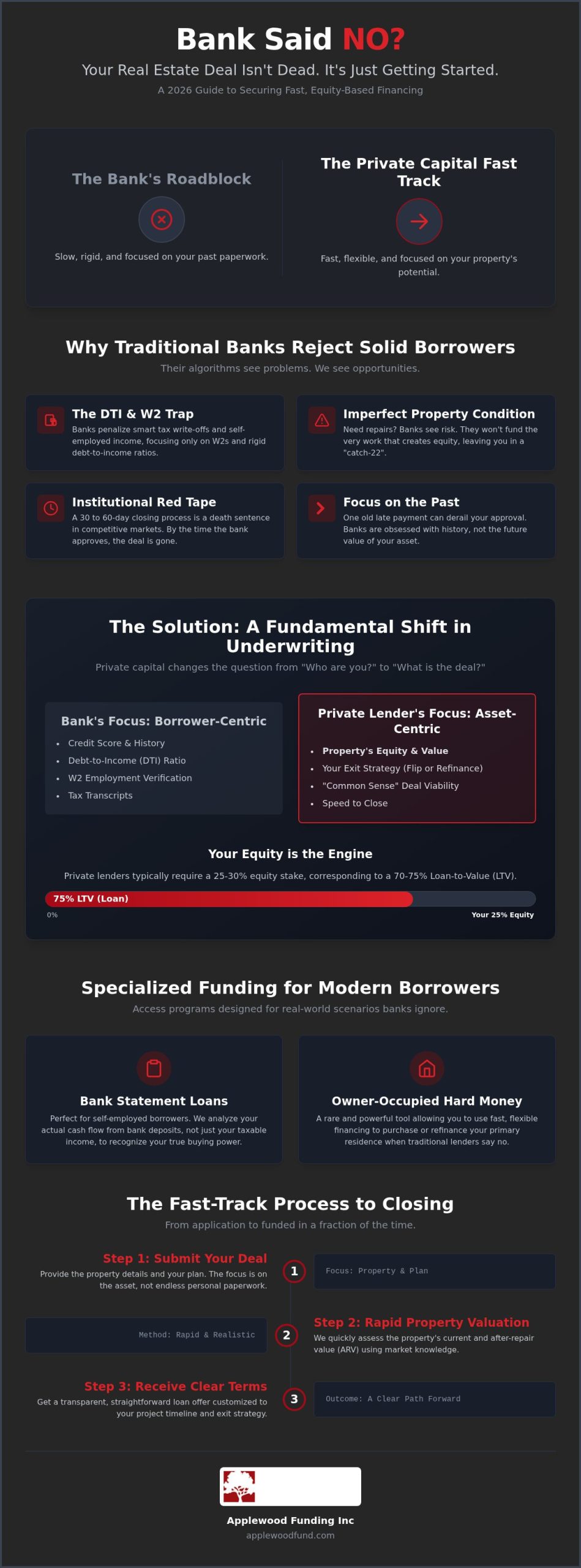
Banks don’t think like entrepreneurs. They think like spreadsheets. In 2026, the gap between bank policy and real-world real estate is wider than ever. You have a great deal, but the bank’s standardized algorithm sees a “square peg.” It doesn’t matter if your property has massive potential. If you don’t fit their rigid box, you’re out. This is why smart investors seek a hard money loan when bank says no. Traditional lenders are retreating from anything that isn’t a “sure thing,” leaving massive opportunities for those who know how to access private capital.
Traditional lenders are obsessed with the past. One late payment from three years ago can derail a 30-day approval process instantly. Then there’s the Debt-to-Income (DTI) trap. High-earning investors often show low taxable income to save on taxes. Banks call that a risk; we call it smart business. They fail to see the future value of the asset because they’re too busy squinting at your old utility bills. It’s a system designed for stability, not for the speed of the 2026 market.
Property condition is another wall. Banks want “turn-key” perfection. If a home needs a new roof or a kitchen update, traditional underwriters run for the hills. They refuse to fund the very repairs that create equity. This leaves you in a catch-22: you can’t get the loan without the repairs, and you can’t do the repairs without the loan. Private funding breaks this cycle by focusing on the property’s potential rather than its current flaws.
The Self-Employed Struggle: Beyond the W2
Your tax return is a work of art, but to a bank, it looks like a rejection letter. Tax write-offs are great for your bottom line but act as “loan killers” during traditional underwriting. They ignore your real-world cash flow and focus only on taxable income. That’s where bank statement loans come in. We look at what’s actually hitting your account every month. It’s a common-sense bridge that recognizes your actual buying power without the W2 baggage.
Institutional Red Tape and Timing
Speed is the currency of the Phoenix and Scottsdale markets. A bank’s 60-day closing cycle is a death sentence for a hot deal. While they’re stuck in committee, your property goes to someone else. There’s also the “Appraisal Gap.” Institutional appraisers often miss the nuances of local Arizona property values. Understanding how a Hard money loan works is the first step to moving faster. You can’t wait for a slow institution when a deal is on the line. For a deeper dive into these differences, check out our guide on Hard Money vs. Traditional Mortgage: Speed, Strategy, and Selection. We prioritize the asset so you can close before the competition even gets a call back.
Hard Money Defined: How Private Capital Bridges the Gap
A hard money loan isn’t a mystery. It’s a straightforward financial tool where the property itself acts as the primary security for the debt. While banks focus on your past, private lenders focus on your property’s future. This shift from “borrower-centric” to “asset-centric” underwriting is the secret to moving fast in a crowded market. You aren’t just a credit score on a page. You’re an investor with a tangible asset. Securing a hard money loan when bank says no is a strategic move that puts you back in the driver’s seat of your real estate goals.
The capital for these loans comes from private investors and specialized funds rather than institutional deposits. This distinction matters. Because private lenders don’t answer to federal banking regulators, they can prioritize common sense over bureaucracy. They look at the “hard asset” first. This form of asset-based lending allows for a level of creativity and speed that traditional banks simply can’t match. It’s not just a “last resort” for those with credit issues; it’s a high-octane tool for anyone who needs to close a deal before the competition even gets their paperwork started.
The Core Mechanics of Private Lending
Equity is the engine here. In the 2026 market, most private lenders look for a Loan-to-Value (LTV) ratio between 60% and 75%. This means you need some “skin in the game,” but in exchange, you get unparalleled speed. Private lenders skip the endless layers of employment verification and tax transcript requests. They want to know the property’s value and your exit strategy. How will you pay the loan back? Whether you plan to flip the house or refinance into a long-term rental loan, the terms are customized to fit that specific timeline.
Hard Money in the 2026 Arizona Market
The Phoenix and Scottsdale markets don’t wait for anyone. If you’re bidding on a fix-and-flip property or a piece of land for construction, you need to prove you can close. Local expertise is your biggest advantage. A lender who understands the nuances of Maricopa County property values is worth more than a dozen out-of-state bank committees. Applewood Funding Inc specializes in this local landscape, providing the agility you need to win competitive bids. We know Arizona real estate because we live here. If you’re ready to move past the rejection letters and start closing deals, speak with our team about your specific property today.
Qualifying for Private Funding: Asset-Based vs. Credit-Based
Banks look at your FICO score like it’s your soul. We look at your property like it’s the solution. In the world of private capital, equity is the only king that matters. Most lenders want to see you have “skin in the game,” typically around 25% to 30%. This isn’t just about risk; it’s about partnership. When you have significant equity, the lender doesn’t need to pore over 100 pages of bank forms or verify every lunch you bought in 2024. This is the fundamental reason you can secure a hard money loan when bank says no. We prioritize the asset, which lets you skip the credit score obsession and move straight to funding.
Your income history matters far less than your exit strategy. How do you plan to pay the loan back? Are you selling the property? Are you refinancing once you’ve improved your credit? A private lender cares more about the “how” of the future than the “why” of the past. This flexibility applies to various property types, from fast-paced fix-and-flips to complex construction sites and even primary residences. While a bank sees a 1099 form as a red flag, we see it as a sign of an active, successful entrepreneur. We replace a mountain of bank bureaucracy with a few key property documents and a clear conversation about your goals.
The Hard Money Approval Checklist
The process is lean and designed for speed. You don’t need a mountain of paperwork. Instead, focus on these three pillars to get your deal across the finish line:
- Property Valuation: A local Arizona appraisal or Broker Price Opinion (BPO) to confirm the current “as-is” value.
- Title Clarity: Ensuring the property is free of surprise liens or legal disputes that could stall a closing.
- Documented Exit: A clear, written plan for repayment, whether through a sale, a business cash flow surge, or a long-term rental refinance.
Overcoming Common Denial Reasons
Even in private lending, hurdles happen. If your Loan-to-Value (LTV) ratio is too high for a specific lender’s comfort, don’t panic. You can often fix this by bringing more cash to the table or pledging additional collateral, like another property you own. Clouded titles are another common roadblock that stop banks cold. We work with local Arizona legal resources to clear up old liens and keep your deal moving. If you’re wondering about your primary residence, read our specific guide: Can I Get a Hard Money Loan on My Home? Your 2026 Arizona Guide. We don’t just list problems. We find the path to “yes” when the big institutions have already walked away.
Specialized Solutions: Owner-Occupied and Bank Statement Loans
Most lenders draw a hard line: private money is for business, not for where you sleep. They tell you that hard money is strictly for investors. We disagree. Finding a hard money loan when bank says no for your primary residence is difficult because of strict 2026 consumer protections, but it isn’t impossible. Big banks see these regulations as a reason to walk away. We see them as a roadmap to help you stay in your home or secure a new one when traditional timing fails you. Equity isn’t just for investors; it’s for homeowners who need to move fast.
Applewood Funding specializes in the rare niche of owner-occupied hard money. We provide the speed you need when facing a time-sensitive purchase or an urgent cash-out requirement. Whether you’re using your home’s equity to fund a business venture or to bridge the gap between properties, we focus on the asset. We also offer powerful bank statement loans for the self-employed. If you have the cash flow but lack a W2, we use 12 to 24 months of deposits to prove your buying power. It’s real-world math for real-world business owners.
Owner-Occupied Hard Money: The Rules
Legal considerations are the main reason most lenders avoid primary residences. In 2026, Dodd-Frank requirements remain a high bar for compliance. We don’t run from these rules; we work within them. Speed is critical when you’re facing a deadline. We prioritize your equity and your exit strategy to ensure you don’t lose your home to a slow bank committee. For a deeper look at this process, see our guide on Owner Occupied Hard Money Loans: Fast Funding for Your Primary Residence. We bridge the gap between institutional “no” and your next “yes.”
The Bank Statement Advantage
You shouldn’t be penalized for being your own boss. Traditional underwriters see tax write-offs as a lack of income, but we see them as smart business. Our bank statement program allows you to qualify without a single W2 or tax return. We calculate your qualifying income by looking at your actual business deposits. This common-sense approach recognizes your true financial strength. Check out our Bank Statement Loans: 2026 Guide for Self-Employed to see how your deposits translate into a mortgage. If you’re ready to stop the paper chase and start the closing process, apply for a specialized hard money solution today.
Securing Your Funding: The Fast-Track Process to Closing
Speed is the ultimate currency in the 2026 Arizona real estate market. While traditional banks are buried under layers of red tape, private funding moves at the pace of your deal. Choosing a hard money loan when bank says no isn’t just a backup plan; it’s a deliberate choice to prioritize action over bureaucracy. We’ve refined the closing process into four high-impact steps designed to get you funded while your competitors are still waiting for a return phone call from a loan officer.
- Step 1: The Initial Consult. We don’t need your life story. We need to talk about the asset and your exit strategy. This conversation sets the foundation for a “yes” by focusing on the property’s potential.
- Step 2: Rapid Valuation. We skip the slow national appraisal chains. Instead, we use local Arizona experts for a Broker Price Opinion (BPO) or rapid appraisal to verify the current “as-is” value of your property.
- Step 3: Underwriting the Asset. Our team verifies the equity and ensures the title is clean. We look for solutions to title issues that would stop a bank cold, keeping the momentum toward closing.
- Step 4: Funding. Once the asset is cleared, we move to the finish line. You can expect to close in as little as 5 to 10 days, providing the liquidity you need exactly when you need it.
Speed as a Competitive Advantage
Winning a bidding war in Peoria or Glendale requires more than just a high offer. It requires proof of funds that can close fast. Private funding allows you to make “cash-like” offers that stand out to sellers who are tired of deals falling through due to bank delays. You avoid the “bank fatigue” of endless document requests and secondary reviews. Local lenders understand the Maricopa County landscape and can pivot faster than national institutions that don’t know the difference between a Scottsdale condo and a Phoenix fix-and-flip. We use local knowledge to make common-sense decisions in real time. If you want to understand exactly how the hard money loan fast approval process works from start to finish, our dedicated guide walks you through every step.
Your Next Steps to a “Yes”
Ready to move forward? Start by gathering your basic property information and a current equity statement. You don’t need a 100-page dossier. Just be prepared to explain your exit strategy narrative. Whether you’re planning to sell after a renovation or refinance once your business cash flow peaks, a clear plan is your best leverage. Don’t let a bank’s rejection letter be the end of your project. Take control of your financing and move toward a successful close. Get a fast hard money quote from Applewood Funding today.
Take Control of Your Funding Today
A bank rejection isn’t the end of your deal; it’s the start of a smarter strategy. You’ve learned that private capital prioritizes your property’s value over a standardized credit score. Whether you are navigating the self-employed struggle or need a fast bridge for a new investment, equity is your greatest leverage. Securing a hard money loan when bank says no allows you to move with the speed the Arizona market demands. You don’t have to be a victim of institutional red tape anymore.
Managed by Joel McDaniel (NMLS 175371), Applewood Funding brings deep expertise to the Phoenix, Scottsdale, and Tucson markets. We specialize in rare owner-occupied hard money programs that other lenders simply won’t touch. We value your time and your vision. It’s time to stop letting automated algorithms dictate your success. Your property has value, and you have a plan. Let’s get them funded. Stop waiting for the bank and get funded now with Applewood Funding. Your next “yes” is just a conversation away.
Frequently Asked Questions
Can I get a hard money loan on my primary residence if a bank denied me?
Yes, you can secure an owner-occupied hard money loan through Applewood Funding. While most national lenders avoid primary residences due to complex regulations, we specialize in these rare programs for Arizona homeowners. We focus on your equity and a clear exit strategy rather than just your tax returns. This is a vital solution for residents in Phoenix or Scottsdale who need to move fast to save a deal or bridge a gap.
How fast can a hard money loan close compared to a traditional bank loan?
A hard money loan typically closes in 5 to 10 days. In contrast, traditional banks often take 30 to 60 days to navigate their bureaucratic committees and verification layers. In competitive Arizona markets like Glendale or Peoria, this speed is a massive advantage. We skip the endless document requests and focus on rapid property valuation to get your capital funded while the bank is still reviewing your initial application. Learn more about how hard money loan fast approval gets you to the closing table in days, not weeks.
Do hard money lenders care about my credit score in 2026?
Credit scores are not our primary focus. We prioritize the value of your real estate and the strength of your equity. A hard money loan when bank says no is designed to bypass the FICO obsession that stalls traditional applications. We look for a 25% to 30% equity stake to secure the deal. This approach allows us to fund projects in Mesa or Tempe that banks would reject over a single late payment.
What is the typical down payment for a hard money loan when banks say no?
You should expect to provide a down payment between 25% and 40%. This translates to a Loan-to-Value (LTV) ratio of 60% to 75%. Because we don’t rely on strict debt-to-income ratios or W2 history, your “skin in the game” serves as the primary security for the loan. Having this equity allows us to move forward with speed and flexibility that institutional lenders simply cannot match in the current 2026 market.
Can I use a bank statement loan if I don’t have W2s?
Yes, our bank statement loans are specifically designed for self-employed entrepreneurs. We use 12 to 24 months of business or personal deposits to calculate your qualifying income. This common-sense approach ignores the tax write-offs that often kill traditional bank applications. It is the perfect solution for business owners in Scottsdale or Sedona who have strong cash flow but don’t fit the rigid documentation requirements of a standard mortgage lender.
What happens if I can’t pay off the hard money loan at the end of the term?
Communication is the most important factor if your exit strategy changes. Most hard money loans are short-term, lasting 6 to 36 months, and are meant to be repaid through a property sale or a traditional refinance. If you can’t pay it off at the end of the term, you should contact us early to discuss an extension or a pivot in strategy. The property serves as collateral, so a solid repayment plan is essential.
Are hard money loans more expensive than bank mortgages?
Yes, hard money loans carry higher interest rates and fees than traditional bank mortgages. In 2026, rates typically range from 8% to 15%. You aren’t just paying for capital; you’re paying for speed, accessibility, and the ability to close a deal that a bank won’t touch. It’s a short-term strategic tool used to secure an asset or bridge a financial gap until you can transition into long-term, lower-interest financing.
Is Applewood Funding a direct lender in Arizona?
Yes, Applewood Funding Inc is a specialized private lender managed by Joel McDaniel (NMLS 175371). We provide direct access to alternative mortgage solutions across Arizona, including Phoenix, Scottsdale, and Tucson. Our local expertise allows us to make fast, common-sense decisions on owner-occupied loans and investment projects. You work directly with a team that understands the Maricopa County landscape and prioritizes your results over institutional red tape and slow bank committees.