


Bank Statement Loans for Investment Property: 2026 Guide
September 1, 2026
Hard Money Loan for Foreclosure Bailout: Save Your Arizona Home Fast
September 2, 2026Hard Money vs. Traditional Mortgage: Speed, Strategy, and Selection in 2026

In the 2026 real estate market, waiting sixty days for a bank approval isn’t just a delay. It’s a deal-killer. While traditional lenders are bogged down by new regulations and rigid internal checklists, the smartest investors are moving faster. The choice between a hard money vs traditional mortgage isn’t about which interest rate looks better on paper. It’s about which financing tool actually puts you in the driver’s seat at the closing table.
You’re likely tired of losing prime properties to cash buyers because your bank’s appraisal process takes forever. If you’re self-employed, you know the headache of proving your worth to a lender who only cares about tax returns, not your actual assets. It’s frustrating to watch a golden opportunity slip away because of bureaucratic red tape and inflexible debt-to-income requirements. We’re here to help you stop the bleeding and start winning deals again.
This article reveals the strategic differences between private capital and bank financing so you can pick the right path for your next move. You’ll discover how asset-based underwriting works, why speed is your greatest competitive advantage, and how to navigate the 2026 lending landscape. We’ll also break down the essential exit strategies you need to transition from short-term debt to long-term wealth.
Key Takeaways
- Learn why hard money can close in as little as 5 to 10 days, allowing you to beat out cash buyers while banks are still reviewing paperwork.
- Discover how asset-based underwriting prioritizes property value over your tax returns, making it the ideal solution for self-employed borrowers.
- Master the cost-benefit analysis of hard money vs traditional mortgage to determine if the price of speed justifies the higher interest rates and points.
- Identify the specific scenarios, like fix-and-flip projects or distressed assets, where traditional 30-year financing simply doesn’t work.
- Understand how to structure a winning exit strategy to transition from high-speed private capital into long-term conventional debt.
Hard Money vs. Traditional Mortgages: The Core Differences
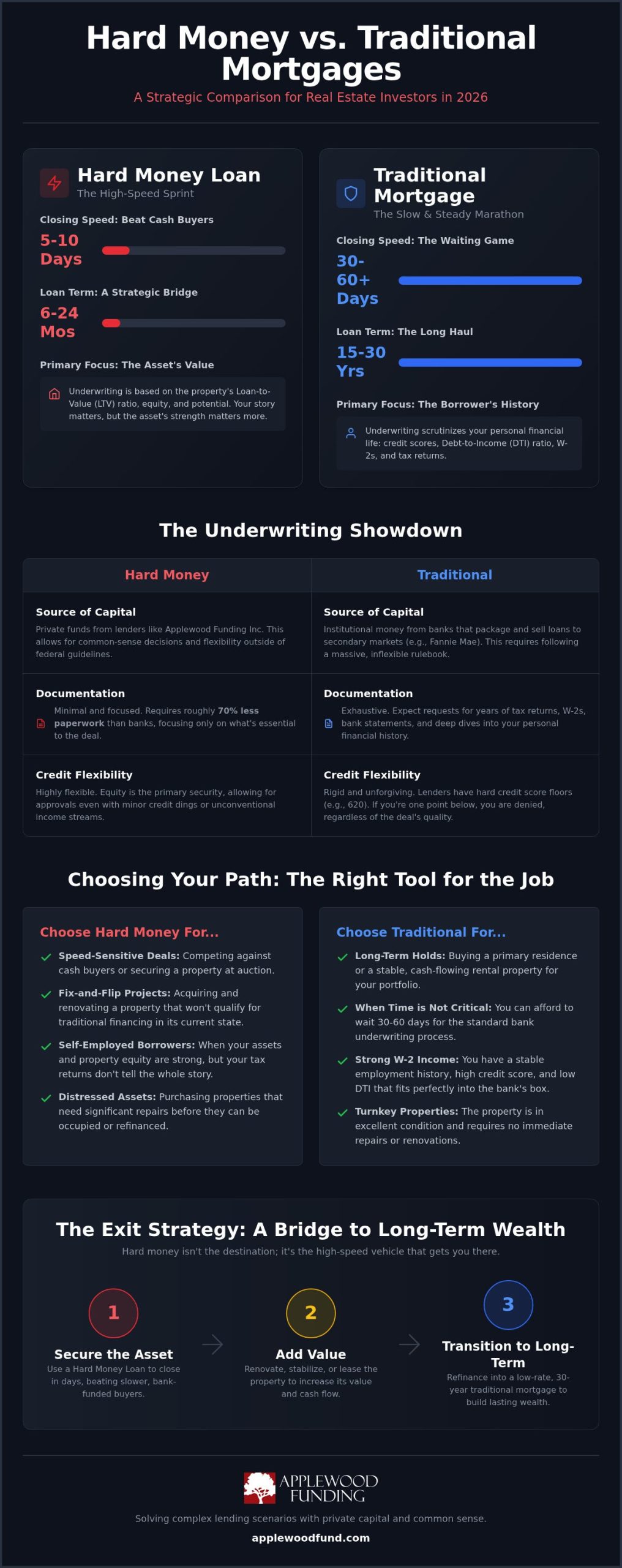
Traditional mortgages are built for the long haul. They provide 15 to 30 years of predictable debt, but they come with heavy strings attached. These loans follow rigid federal guidelines and institutional requirements. If you don’t fit their specific box, you don’t get the money. A Hard money loan works differently. It’s short-term capital, usually lasting 6 to 24 months, provided by private lenders like Applewood Funding Inc. Hard money serves as a strategic bridge to permanent financing, allowing you to secure an asset quickly before transitioning to a long-term solution.
The fundamental “why” behind these two options comes down to what the lender values most. Banks prioritize borrower stability and historical data. They want to see a track record of consistent income and low risk. Hard money lenders prioritize property equity and the viability of the project. This shift in focus changes everything about how you secure your next real estate deal. When comparing a hard money vs traditional mortgage, you’re choosing between a slow, steady marathon and a high-speed sprint.
The Source of Capital: Institutional vs. Private
Traditional loans rely on secondary markets. Banks and credit unions package their mortgages and sell them to entities like Fannie Mae or Freddie Mac. Because of this, they must follow a massive, inflexible rulebook. One small deviation from federal standards can trigger a rejection. This institutional reliance is why your bank takes 45 days just to tell you “maybe.”
Private capital allows for outside the box underwriting and common-sense decisions. Applewood Funding Inc doesn’t answer to the secondary market. We use our own capital to fund your vision. This independence dictates the speed of your closing. When the money is private, the decision-making process is direct and decisive. You aren’t a file number in a global queue; you’re a partner with a specific asset.
Underwriting Focus: The Borrower vs. The Asset
Banks will scrutinize your life for months. They demand years of tax returns, W-2s, and deep dives into your debt-to-income (DTI) ratio. If you’re self-employed or have a complex financial structure, this bureaucratic red tape can stall your progress indefinitely. They look at your past to predict your future. It’s a slow and often frustrating process that doesn’t account for the property’s actual value.
Hard money focuses on the property’s potential and the Loan-to-Value (LTV) ratio. We look at what the property is worth today and what it will be worth tomorrow. This asset-based approach saves deals that traditional underwriters would kill over minor credit dings or unconventional income streams. It’s a faster, more logical way to fund real estate in a competitive market.
- Traditional: Focuses on DTI, credit scores, and W-2 history.
- Hard Money: Focuses on property value, equity, and exit strategy.
- Traditional: Funded by institutions with 30-year horizons.
- Hard Money: Funded by Applewood Funding Inc for 6 to 24-month cycles.
The Underwriting Process: Red Tape vs. Rapid Approval
Banks love red tape. They thrive on it. For them, a 45-day closing is considered fast. For you, it’s a lost opportunity. Traditional timelines often stretch from 30 to 60 days as your file moves through endless committee reviews and internal audits. Hard money changes the game. You can close in as little as 5 to 10 days. This allows you to beat cash competitors who think they have the upper hand. You get the speed of a cash buyer with the leverage of a professional lender.
The paperwork difference is massive. Private lenders require roughly 70% less documentation than big banks. We don’t bury you in requests for irrelevant data or decades of personal history. Speed doesn’t mean we skip the due diligence; it means we focus on what actually matters. We verify the asset, the title, and the exit strategy quickly so you can take action. When comparing a hard money vs traditional mortgage, the choice is clear: do you want to wait for permission or win the deal?
Credit Requirements and Flexibility
Conventional lenders have hard floors for credit scores. If your score is 619 and their floor is 620, you’re out. They don’t care about the property’s potential or your plan for the asset. Hard money lenders view equity as the primary security. This allows for incredible credit flexibility that banks simply cannot match. You can use private capital to secure a distressed property today while you repair your credit for a future refinance. It’s a strategic tool designed to help you bridge the gap between where you are and where you want to be. If you’ve recently faced a denial, understanding how to secure a hard money loan when bank says no can turn that rejection into your fastest path to closing.
Income Verification: W-2s vs. Bank Statements
Self-employed borrowers struggle with traditional banks because of tax write-offs. A bank sees a legal deduction and thinks you have no income. We see the actual cash flow in your business bank accounts. Applewood offers bank statement loans for the self-employed that look at your actual deposits over the last 12 to 24 months. We verify your ability to pay without demanding W-2s that don’t tell the whole story. This approach focuses on your current financial strength and business success, not just what you told the IRS last year. It keeps your real estate moves on track when traditional underwriters say no.
Cost Analysis: Rates, Points, and the Math of Speed
Interest rates are the first thing most borrowers look at, but they shouldn’t be the only thing. In a hard money vs traditional mortgage comparison, the cost structure is fundamentally different because the goals are different. Conventional loans are market-linked and designed to be paid back over decades. Hard money is risk-adjusted capital designed for a quick turnaround. You aren’t just paying for money; you’re paying for the ability to move instantly. Hard money is expensive capital for a short time rather than cheap capital for a long time.
While a bank might offer a lower rate, they also demand a fully amortizing payment where you pay principal and interest every month. Most private capital deals are structured as interest-only. This keeps your monthly carry costs low while you focus on the property. You’ll also encounter points, which are upfront origination fees. These points cover the cost of the rapid underwriting and the private nature of the capital. When you run the math, the cost of these points is often a small fraction of the profit you’d lose by waiting on a bank.
The Balloon Payment Explained
A balloon payment is the standard exit in private lending. Unlike a 30-year loan that slowly disappears, a hard money loan requires the full principal balance to be paid at the end of the term. This is why your exit strategy is the most important part of the deal. You need a clear Plan A, such as selling the renovated property, and a solid Plan B, like refinancing into a long-term rental loan. Risk management means knowing exactly how you’ll pay that balloon before you ever sign the contract. We prioritize your exit strategy during the initial conversation to ensure the deal makes sense for your bottom line.
Loan-to-Value (LTV) and Down Payments
Banks can offer low down payments because they’re subsidized or insured by the government. Private lenders require more skin in the game, typically asking for 20% to 30% down. This higher LTV protects the lender and ensures the borrower is committed to the project’s success. However, Applewood Funding offers strategies to mitigate this. We can use cross-collateralization, where you use the equity in a property you already own to secure the new loan. This can significantly reduce your cash-out-of-pocket and keep your liquidity high for other moves. It’s about using your existing assets to fuel your future growth.
Strategic Use Cases: When Speed Beats a Low Rate
Speed isn’t just a convenience. In a low-inventory market, it’s your most potent weapon. When you compare a hard money vs traditional mortgage, you’re looking at two different playbooks. One is for long-term stability. The other is for tactical execution. If you’re trying to win a bidding war against cash buyers, showing up with a 45-day bank pre-approval is like bringing a knife to a gunfight. You need the ability to move now.
Fix-and-flip investors know this reality best. A traditional 30-year mortgage is the wrong tool for a property that needs a new roof and a kitchen gut. Banks won’t touch distressed assets because they don’t fit the standard appraisal box. We fund these projects based on the after-repair value (ARV). This gives you the capital to buy, renovate, and sell before a bank would even finish their first round of committee reviews. The same logic applies to ground-up construction and land deals where traditional lenders see too much risk and not enough historical data.
The Cost of Losing a Deal
Successful investors focus on profit, not just interest rates. Let’s look at the numbers. Suppose you find a property with $50,000 in immediate equity, but the seller needs to close in ten days. A traditional bank will take 60 days. If you use hard money and pay 4% more in interest over six months on a $300,000 loan, your extra cost is roughly $6,000. Would you pay $6,000 to secure $50,000 in equity? Most professionals make that trade every single day. Hard money allows you to act like a cash buyer, securing the asset while your competitors are still filling out bank forms.
Owner-Occupied Hard Money: A Rare Solution
Most hard money lenders run away from primary residences. They fear the regulatory complexity of Dodd-Frank and the extra paperwork involved. We don’t blink. Applewood Funding specializes in Owner Occupied Hard Money Loans for homeowners who need a bridge to their next move. This is a vital tool if you’re self-employed and facing a sudden rejection from a traditional bank, or if you need to buy a new home before your current one sells. If you’re wondering can I get a hard money loan on my home, our Arizona guide breaks down the equity requirements, federal income verification rules, and how to leverage your primary residence for fast, equity-based funding. We provide the capital to secure your family’s future, giving you the breathing room to refinance into a conventional loan later on your own terms. It’s a rare solution for a common problem.
- Fix-and-Flip: Fund renovations that banks won’t touch.
- Bridge Financing: Buy your next home before selling the old one.
- Construction: Get ground-up projects moving without bank delays.
- Primary Residences: Secure your home when traditional underwriting fails.
Choosing Your Path: How Applewood Funding Inc Simplifies the Choice
Choosing the right tool is about more than just numbers; it’s about aligning your capital with your specific project goals. In the 2026 market, where the 21st Century ROAD to Housing Act has tightened institutional lending, the gap between a hard money vs traditional mortgage has become even more pronounced. If your deal requires a 10-day close to beat a competitor, the bank is already out of the running. They aren’t built for speed; they’re built for safety. Applewood Funding Inc prioritizes your success by focusing on the asset’s potential rather than just your tax returns. Our common-sense underwriting approach cuts through the bureaucratic noise that stalls most deals today.
Ask yourself one question: Does the deal survive a 45-day wait? If the answer is no, you need a private capital partner. We look at the equity you’re bringing to the table and the exit strategy you’ve designed. Whether you’re planning a short-term bridge to a later refinance or a quick fix-and-flip, your loan must match your timeline. Applewood Funding Inc helps you align those factors so you don’t get stuck with the wrong debt at the wrong time. We bridge the gap between where you are and where you need to be.
The Applewood Funding Inc Advantage
We provide national reach with a high-energy service model. You don’t wait weeks for a committee to meet. You get direct access to decision-makers who give you rapid “Yes” or “No” answers. From bank statement loans for the self-employed to complex construction and land projects, our product suite is built for the modern entrepreneur. We fund the deals that traditional banks find too “outside the box.” Applewood Funding Inc values your results more than your paperwork. Our team acts as your fast-moving ally in a competitive landscape.
Ready to Move? Your Next Steps
Preparation is speed. If you want to close in days, not months, have your data ready. We need to see the property value, your renovation budget, and a clear plan for how you’ll pay the loan back. Don’t let a great property slip away while you’re waiting for a bank appraisal that might never come. Take control of your real estate future today. We make the process simple, direct, and incredibly fast. Success favors the bold and the prepared.
Apply for your hard money loan now with Applewood Funding Inc.
- Evaluate: Does the deal require a 10-day close?
- Assess: Is the asset distressed or “outside the box”?
- Match: Align your loan with a clear exit strategy.
- Act: Connect with direct decision-makers today.
Take Control of Your Real Estate Future
Real estate in 2026 waits for no one. The choice between a hard money vs traditional mortgage isn’t just about interest rates; it’s about maintaining total control over your timeline. You’ve seen how asset-based underwriting can bypass the bureaucratic red tape that kills deals at big banks. Whether you’re navigating a complex fix-and-flip or need a rare owner-occupied bridge loan, the right capital makes all the difference. Applewood Funding provides nationwide coverage and direct access to decision-makers who look at your property’s potential, not just your tax returns.
We prioritize speed and simplicity so you can act like a cash buyer and win the deals your competitors lose. Don’t let another opportunity slip away because of a slow appraisal or an inflexible debt-to-income requirement. Our team is ready to help you move faster and smarter than the rest of the market. Success in this industry belongs to those who act decisively. Get Your Fast Hard Money Quote from Applewood Funding Inc and start building your portfolio with confidence today.
Frequently Asked Questions
Can I get a hard money loan for my primary residence?
Yes, you can. While many private lenders avoid primary residences due to regulatory complexity, Applewood Funding Inc specializes in Owner Occupied Hard Money Loans. This product is a rare tool for homeowners who need to secure a property quickly when traditional banks say no. It acts as a vital bridge, giving you the capital to move in now and the time to refinance into a conventional loan later on your own terms.
Is a hard money loan more expensive than a traditional mortgage?
Yes, it is. Hard money is risk-adjusted, short-term capital, which means higher interest rates and origination points. When you weigh the cost of a hard money vs traditional mortgage, you have to look at the opportunity cost. Losing a deal with significant equity because a bank took months to decide is far more expensive than paying a higher rate for a short project window to win the property.
How fast can a hard money loan close compared to a bank?
A hard money loan can close in as little as 5 to 10 days. Traditional bank mortgages usually require 30 to 60 days for documentation and committee approvals. This speed happens because private lenders focus on the asset’s value rather than your entire financial history. If you’re competing in a low-inventory market, this rapid approval process allows you to act like a cash buyer and close before your competitors even finish their paperwork.
Do hard money lenders require a high credit score?
No, a high credit score isn’t the primary requirement. Traditional banks have hard floors that trigger automatic rejections for lower scores. Private lenders prioritize the property’s equity and the Loan-to-Value (LTV) ratio instead. We look at the strength of the deal and your exit strategy. This flexibility makes hard money an ideal solution for self-employed borrowers or those currently repairing their credit while building their real estate portfolio through asset-based lending.
What happens if I cannot pay off the hard money loan at the end of the term?
If you can’t pay the balloon payment at the end of the 6 to 24-month term, you risk default and foreclosure. This is why having a rock-solid exit strategy is mandatory before we fund any deal. Most borrowers plan to either sell the property for a profit or refinance into a long-term rental loan. We work with you to ensure your Plan B is as strong as your Plan A before you ever sign the contract.
Can I refinance a hard money loan into a traditional mortgage later?
Most private lenders look for a maximum LTV of 70% to 75% of the property’s value. This requirement ensures the borrower has enough skin in the game to minimize risk for the lender. However, Applewood Funding Inc offers strategies like cross-collateralization to help you leverage existing equity in other properties. This can reduce your cash-out-of-pocket while still meeting the necessary equity requirements to get your deal funded and closed quickly.
Why do investors use hard money if the rates are higher?
Investors prioritize profit over interest rates. When you analyze a hard money vs traditional mortgage, you see that speed often generates more wealth than a low rate ever could. Hard money allows investors to buy distressed properties that banks won’t touch or to close deals in days to beat out other bidders. It’s a high-performance tool used to capture equity that would otherwise be lost to the slow pace of institutional banking. For a complete breakdown of your private funding options after a bank denial, our 2026 guide to securing a hard money loan when bank says no walks you through every step of the process.