

Alternative lending for homeowners: Qualification and refinancing options
October 23, 2026Mesa Fix and Flip Financing 2026: August Loan Rates and Terms

Hard money can keep a Mesa flip moving, but the rate depends on the deal. For Mesa fix-and-flip financing in 2026, August market estimates put loan rates at roughly 9% to 13%. Your leverage, renovation scope, and track record can all affect where a project lands within that range.
That spread matters when a renovation takes longer than planned or the property needs more work than expected. You want a financing model that accounts for both the rehab and the time you’ll carry the loan, not just the purchase. This guide explains what shapes rates, how Mesa-area conditions and property type can influence financing, and how to build a realistic renovation and carry-time plan. You’ll also see where hard money fits when a project needs financing structured around the property and its renovation, rather than a conventional mortgage timeline.
Key Takeaways
- Compare loan terms alongside the interest rate. Leverage, renovation scope, and your project history can all shape the financing offer.
- Use Mesa-area comparable sales and the property’s condition to build a grounded after-repair value estimate.
- Match the financing plan to the property and your experience, then account for the cash needed to complete the work.
- Build renovation milestones and draw timing into your schedule so delays don’t catch your budget off guard.
- Model a longer carry period than your best-case timeline, with a contingency for rehab overruns and a slower resale.
1. What fix-and-flip loan rates should I expect in August 2026?
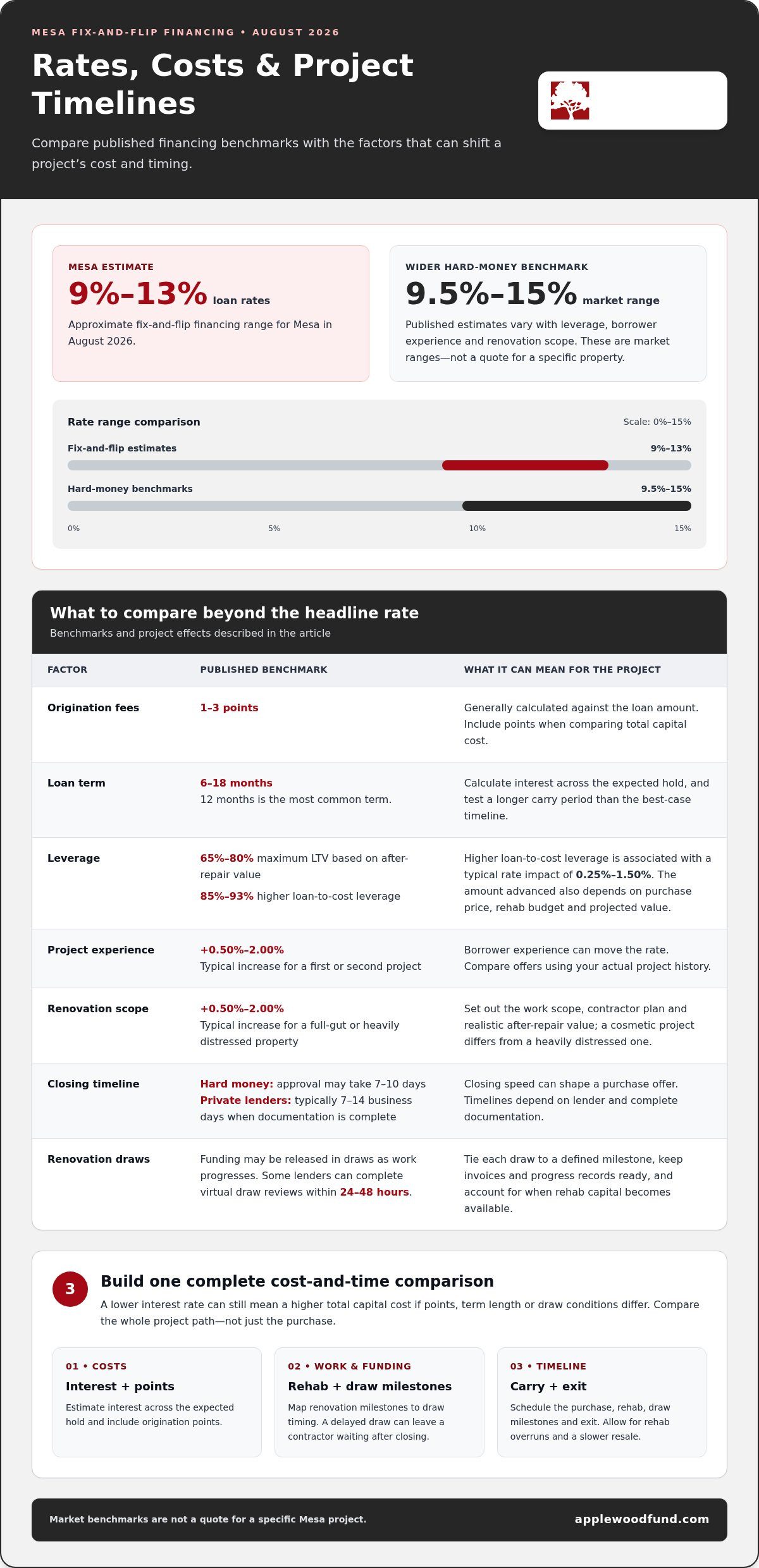
For August 2026, U.S. fix-and-flip loan estimates range from roughly 9% to 13%. Hard money benchmarks run wider, from 9.5% to 15%, while published rates vary with loan-to-value, borrower experience, and renovation scope. Treat these figures as market ranges, not a quote for a specific Mesa project. Compare the full terms, not just the interest rate.
Origination fees commonly run 1 to 3 points. Loan terms typically span 6 to 18 months, with 12 months the most common term. Those points are generally calculated against the loan amount, so include them when comparing a bridge loan with another financing structure. A lower rate can still mean a higher total capital cost if points, term length, or draw conditions differ.
Leverage depends on how the lender measures the project. Published maximum loan-to-value ratios based on after-repair value range from 65% to 80%. Higher loan-to-cost leverage of 85% to 93% is associated with a typical rate impact of 0.25% to 1.50%. These are market benchmarks, not automatic limits; the purchase price, rehab budget, and projected value all affect the amount a lender may advance.
Experience and property condition can move the rate, too. A first or second project is associated with a typical increase of 0.50% to 2.00%. A full-gut renovation or heavily distressed property can also add 0.50% to 2.00%. Build your comparison around the scope of work, contractor plan, and realistic after-repair value, rather than assuming every flip loan uses the same rate.
Closing speed can shape a purchase offer. Hard money lenders may approve a house-flipping loan in 7 to 10 days; private lenders typically close in 7 to 14 business days when documentation is complete. Renovation funding may be released in draws as work progresses. Map each draw to a defined milestone, keep invoices and progress records ready, and ask how reviews are handled. Some lenders offering faster renovation draw management can complete virtual draw reviews within 24 to 48 hours.
Before signing, calculate interest across the expected hold, then add points and account for when renovation capital becomes available. A delayed draw can leave a contractor waiting even after closing. Put the purchase, rehab budget, draw milestones, and exit timeline into one project schedule. That gives you a clearer comparison of August rates and terms, and shows whether the proposed leverage can support the flip from acquisition through resale.
2. Fix-and-flip market conditions and geographic variation
National returns show why location and acquisition discipline matter. ATTOM reported a 23.1% gross profit margin on U.S. home flips in Q3 2025, the lowest since 2008. The median gross return reached 25.4% in Q1 2026, with gross profit of $66,000. These are broad benchmarks, not forecasts for a specific Mesa property. Local purchase prices, comparable sales, repair needs, and resale demand shape the deal.
Inventory conditions change the acquisition strategy. In Q1 2026, cash buyers accounted for 61.1% of U.S. flips, creating competition for suitable properties. Before making an offer, compare recent closed sales with active listings and pending deals in the same part of Mesa. Check whether renovated homes are moving at prices that support your projected after-repair value. If inventory is limited, avoid stretching the purchase price just to secure a project.
Geographic returns vary sharply. In Q2 2025, Pittsburgh recorded a 106.8% gross return, while Buffalo exceeded 109%. Cleveland’s gross return was 72% in 2024. Atlanta’s home-flipping rate was 11.1% in Q3 2025, a measure of activity rather than profit. Those figures describe different markets and periods, so they aren’t interchangeable rankings. Use them to see how widely outcomes can differ, then judge Mesa using neighborhood-level sales and property conditions.
Phoenix-area examples can provide regional context, but they are not a forecast for a Mesa property. Every project depends on its own acquisition, renovation, financing, and resale assumptions. For a Mesa deal, build a conservative resale estimate using comparable nearby properties, then subtract purchase, renovation, holding, and closing costs. Test a lower sale price and a longer marketing period before committing capital.
Choose the exit before acquisition. A resale strategy depends on buyer demand for the finished home, while a rental strategy depends on rent, operating costs, and the property’s condition after repairs. If resale margins look tight, compare the project’s rental potential rather than relying on a quick closing. A longer hold changes the financing and cash-flow needs, so model that path separately. A Mesa fix-and-flip financing plan for 2026 should fit the location, not just the renovation budget.
Screen each property by checking nearby sales, reviewing the repair scope, estimating buyer demand, and calculating the margin after project costs. Compare resale and rental exits using the same acquisition assumptions. This helps reveal thin margins before you make an offer, and prevents a desirable neighborhood from standing in for property-specific evidence.
3. What property types qualify for fix-and-flip loans?
A fix-and-flip financing review considers the property and renovation plan. Organize the purchase details, repair scope, estimated costs, and intended exit so the project is easy to assess. A home needing cosmetic updates has a different work plan from a heavily distressed property. Identify the repairs, estimate their costs, and explain whether you intend to resell the finished home or keep it as a rental.
Credit benchmarks vary across lenders. Published minimum credit-score requirements start around 600, while common borrower expectations fall around 660 to 680 FICO. Better terms may be available above 720. These figures are guideposts, not interchangeable approval rules. A borrower should review the full credit profile, including repayment history and existing obligations, alongside the project’s purchase price and renovation plan.
Experience can strengthen the application. Lenders commonly assess a borrower’s track record over the previous 24 to 36 months. A profile with 10 or more completed flips in the last 36 months is identified as a low-rate borrower profile. If you’re newer to real estate, document relevant project responsibilities, contractor arrangements, and a clear sequence of work. A precise plan helps show how you’ll manage the property from acquisition through resale.
Credit and property condition work together. A lower credit profile can affect financing terms, while major repair needs can raise execution risk. Explain how the scope supports the projected after-repair value, and separate essential repairs from optional upgrades. Include contractor estimates and a realistic work sequence. The lender needs to understand not just what the property requires, but how the borrower can complete the plan and reach the intended exit.
Liquidity matters because project expenses come due as work progresses. Map the funds available for acquisition contributions, closing expenses, scheduled repairs, and unexpected work. Keep renovation estimates separate from personal funds, and track when each expense is due. A sound purchase price can still create a cash-flow problem if funds are unavailable when contractors need payment or an inspection triggers the next phase.
For Mesa, Arizona projects, plan licensing, tax, and property compliance around the work performed, ownership structure, and intended resale or rental exit. Address those factors in the project scope, records, and schedule before acquisition. Match the loan request to the property’s condition and your experience, then present credit, available liquidity, contractor plans, and the exit strategy as one coherent financing case.
4. Carry-time and renovation timeline modeling
A flip’s calendar affects interest, utilities, insurance, and the cash available for repairs. The average U.S. home flip took 165 days in Q1 2026, compared with 161 days in Q3 2025. The 2025 average was approximately 163 days. Use these figures as planning context, not a shortcut for estimating your own Mesa project. Property condition, contractor sequencing, permit reviews, and resale closing all affect carry time.
Build a schedule from acquisition to sale, then test each stage. Fix-and-flip projects commonly take 4 to 6 months from acquisition through resale closing. A 90-day renovation followed by a 30-day sale assumes everything goes right. Experienced investors doing cosmetic-only work in controlled markets may finish in 90 to 120 days, but that pace doesn’t fit every property. Underwrite for at least six months, even if your target is four.
Include a delay buffer before signing. Some municipalities can add 4 to 8 weeks through permit review cycles. Contractor availability, material delivery, inspection timing, and lender draw reviews can also disrupt the sequence. Add likely delays to the calendar, then recalculate carrying costs against the revised sale date.
Set a renovation budget that reflects the property’s condition. Rehabilitation and carrying expenses can equal 20% to 33% of after-repair value. Build a 15% to 20% rehab contingency into the plan. Keep that reserve separate from the initial contractor estimate, so a hidden repair doesn’t consume funds earmarked for completion.
Link each renovation phase to the work completed and the records that document it. Before work begins, divide the project into clear stages, such as demolition, rough systems, and finish work. Identify supporting records, including invoices, progress photos, and inspection results, and account for draw review in the schedule.
Track each phase’s planned start, planned completion, inspection, and expected draw release. Compare actual progress with the schedule regularly. If a milestone slips, update the resale closing estimate and carrying-cost plan promptly. Review the purchase price, renovation budget, contingency, and revised hold period together, since separate estimates can hide a cash gap. A realistic timeline gives the lender, contractor, and project budget consistent assumptions.
5. Hard money fix-and-flip lending
Alternatives include cash, conventional investment-property financing, and partner capital. FHA 203(k) rehabilitation loans require borrowers to live in the property, so they aren’t suitable for investment flips. Choose based on the property’s condition, renovation needs, available funds, and planned exit.
Hard money is a short-term bridge loan designed around the property and project. In Lightning Docs’ Q2 2026 analysis, the national average hard money loan rate was 10.41%, and the average loan amount was $546,703. Those national figures offer context, not a quote for a Mesa purchase. Compare the actual rate, points, term, leverage, and draw process together.
Terms vary across published benchmarks. Hard money loans for house flipping typically run 6 to 18 months; fix-and-flip loans commonly have 12- to 18-month terms. The shorter timeline can suit a defined renovation and resale plan. It can create pressure if permitting, contractor schedules, or buyers delay the exit, so match the term to a realistic completion and closing schedule.
Leverage depends on both purchase costs and projected value. Rehab lenders commonly lend up to 75% of after-repair value, with some offering up to 90% for experienced investors. A lender may also evaluate loan-to-cost, borrower experience, credit, property condition, and the renovation plan. Review what the loan covers at acquisition and how repair funds become available; a large headline limit doesn’t necessarily mean all project costs are funded upfront.
Borrower history can shape access and terms. Common fix-and-flip FICO expectations are 660 to 680, with better terms available above 720. Lenders commonly review a borrower’s track record over the previous 24 to 36 months. Bring a clear scope of work, contractor estimates, purchase details, and a supportable after-repair value. That lets the lender assess the project rather than relying on the borrower’s credit score alone.
Cash avoids loan interest but ties up capital. Conventional financing may suit a property that meets its underwriting and condition requirements, while partner capital can share funding and project risk. A rental exit may call for a different long-term financing plan after stabilization. Compare each route by timing, cash contribution, renovation funding, and exit flexibility, not simply by the advertised rate.
For a Mesa flip, lay out acquisition, renovation funding, carry time, and resale in one plan before choosing a bridge loan. Discuss your Mesa flip financing plan as you compare the project’s funding needs and exit strategy.
Applewood Funding: Owner Occupied Hard Money Loans
Applewood Funding Inc offers financing options for property owners and real estate investors, including Fix and Flip Loans for renovation-and-resale projects. If you plan to live in the property, Owner Occupied Hard Money Loans may fit a different financing need. For a completed flip that you intend to keep as a rental, explore Rental Property Loans. The right direction depends on the property’s use and your project’s next step.
Bring your acquisition details, renovation scope, expected timeline, and planned exit strategy into the conversation. That gives you a clear starting point for discussing how financing may fit the project. If you’re ready to talk through your Mesa property plans, contact Applewood Funding Inc.
Turn Your Mesa Deal Into a Clear Next Step
Before moving ahead, write a brief that states what you want the property to become, what would make you pause, and which assumptions need the closest attention. This keeps the financing discussion focused on the Mesa deal you are considering, rather than a generic flip.
Use that brief to compare your options and decide whether to pursue the acquisition, revise the plan, or wait for a better fit. A disciplined pause can be a productive move, too. The goal of mesa fix and flip financing in 2026 is not simply to secure capital; it’s to choose financing that supports a project you can execute.
Ready to discuss your plans? Contact Applewood Funding about financing and take the next step with a clearer plan. Your next Mesa opportunity starts with a decision you can explain and stand behind.
Frequently Asked Questions
What fix-and-flip loan rates should I expect in August 2026?
Expect U.S. fix-and-flip rates around 9% to 13% in August 2026. For Mesa fix-and-flip financing in 2026, compare the full loan structure, not just the rate: origination points, term, leverage, and renovation draw rules all affect your project budget. Ask for a written breakdown, then model interest over your expected hold and a longer delay scenario. That comparison shows how financing changes your planned exit.
What property types qualify for fix-and-flip loans?
Qualification depends on the property’s condition, repair plan, value after renovation, and intended exit. A property with a clear scope and supportable resale estimate gives the lender a basis to assess the project. For example, separate cosmetic improvements from structural or system repairs in your work plan. If you plan to keep the finished property as a rental rather than resell it, evaluate financing designed for a rental exit.
Can I get a fix and flip loan with a mediocre credit score?
Possibly; published minimum credit-score requirements start around 600, while common expectations are 660 to 680. A 620 to 640 FICO profile is associated with a typical rate impact of 0.50% to 1.25%. Applewood Funding, a private hard-money lender, states no credit required and “No Up-Front Fees – No Cost to Apply.” For its Arizona lending, text or call 602-497-4444 to get started.
How is ARV determined, and who calculates it?
ARV is an estimate of a property’s value after planned repairs. Start by comparing similar nearby homes sold within the previous 90 days and within a quarter mile, then adjust for condition, layout, and upgrades. A lender may review the estimate using its valuation process. Keep comparable sales and contractor scope together, so the projected finished value reflects the work planned rather than an optimistic asking price.
How much cash do I need to start flipping houses?
Cash needed depends on purchase price, financing structure, renovation scope, and available loan leverage. Investment properties typically require a 15% to 25% down payment, and rehab budgets should include a 15% to 20% contingency. Build a worksheet that separates your acquisition contribution, closing expenses, repairs, and carry costs. Keep funds available for expenses that arise before a renovation draw is reviewed or released.
How quickly can a fix-and-flip loan close?
Hard-money lenders may approve a house-flipping loan in 7 to 10 days; private lenders typically close in 7 to 14 business days when documentation is complete. Approval and closing aren’t the same milestone. Prepare purchase details, renovation plans, contractor estimates, and borrower information early. For a Mesa offer with a firm closing date, organize these materials before submitting the loan request and track any outstanding items.
What are red flags to watch for in a fix and flip lender?
Watch for terms that don’t clearly explain the rate, points, maturity date, extension process, or renovation draw requirements. Ask for the complete written structure before relying on a projected budget. A mismatch between the stated loan amount and the funds available at each project stage can leave contractors waiting. Also compare the lender’s valuation assumptions with your own comparable sales and repair scope before committing to an acquisition.
What down payment and credit score do Mesa fix-and-flip lenders require?
Market benchmarks put investment-property down payments at 15% to 25%; published minimum credit requirements start around 600, with common expectations of 660 to 680. Actual terms vary with leverage, borrower history, and property condition. Applewood Funding Inc Licensed AZ Mortgage Broker and Licensed Loan Originator NMLS‑175371 AZ MB‑0903207 is a private hard-money lender. Owner Occupied Home OK; terms range from 3 to 360 months. “You Will Get the Lowest Rates GUARANTEED.”